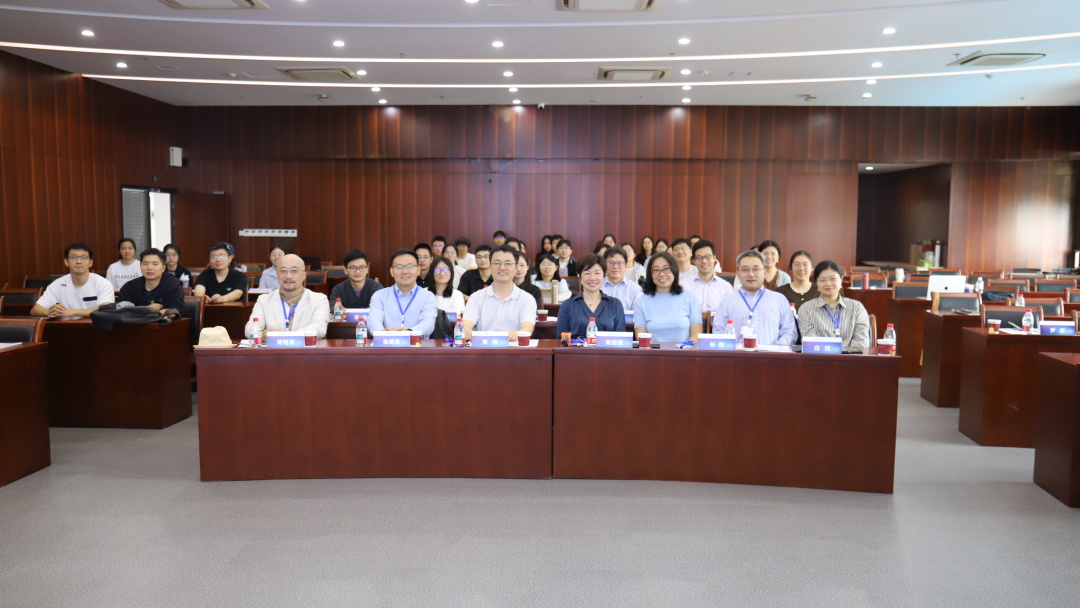
On October 13, 2026, the thematic seminar entitled “New Demographic Landscape and Frontiers of the Labor Market” was held at the School of Economics, Shanghai University of Finance and Economics. Hosted by the School of Economics, SUFE, and co-organized by the Key Laboratory of Mathematical Economics (Ministry of Education, SUFE) and the Population Economics Committee of the China Population Association, the seminar was supported by a major project of the National Social Science Fund of China, namely “The Logic, Patterns and Laws of Coordinated Population and Economic Development”. It brought together distinguished labor economists and outstanding doctoral students from Peking University, Tsinghua University, Renmin University of China, Zhejiang University, Minzu University of China, Shanghai University of Finance and Economics and other domestic universities. The event aimed to facilitate research cooperation and advance the development of labor economics in China through high-level academic exchanges.
Professor Chen Yuanyuan, Deputy Dean of the School of Economics, SUFE, delivered the opening remarks. She briefed the participants on the academic achievements and disciplinary development of the Department of Labor Economics in recent years, and underscored the value of this seminar for advancing labor economics research and academic exchange. She expressed the hope that the exchanges would broaden scholars’ research horizons and foster closer academic collaboration.
Professor Ang Sun from Renmin University of China presented a paper titled From School Tracks to Life Tracks: General versus Vocational Education and Career-Family Trajectories in China. Focusing on China’s tracking system between general and vocational education at the senior high school stage, the study explores the long-run impacts of different educational paths on individuals’ career trajectories, social status and family formation. Combining administrative records of two cohorts of junior high school graduates (2007 and 2009) with an alumni survey conducted in 2022, it uses the admission cutoff scores for general senior high schools to implement a fuzzy regression discontinuity design and identify the causal effects of educational tracking. The research shows that the effects of tracking are not limited to earnings; they emerge early along non-monetary dimensions including industry of employment, occupational status, marriage and fertility.
Associate Professor Sai Luo from SUFE delivered a presentation entitled Skill Imbalance, College Major Choice, and Labor Market Outcomes. The study documents that students with higher within-test-skill imbalance earn persistently lower incomes in the long run, even holding constant their aggregate gaokao scores. Tracking nearly 200,000 gaokao examinees over an 18-year employment and earnings panel, it finds that moving from the 10th to the 90th percentile of skill imbalance reduces average annual earnings by roughly 2.6 percent. This “skill imbalance penalty” is concentrated in majors requiring strong skill complementarity; the penalty is substantially mitigated when students’ skill profiles match the market returns of their chosen majors.
Professor Wei Huang from Peking University presented The Long Shadow of Destruction: Early-life War Exposure, Cohort Collapse, and Intergenerational Persistence. Set against the backdrop of the Second Sino-Japanese War (1931–1945), the paper examines how childhood exposure to war shapes life-cycle development, intergenerational transmission and socioeconomic welfare. Merging historical battle records, census data and household panel surveys, it exploits variation in war exposure across regions and birth cohorts to identify long-run causal effects. The empirical results indicate that early-life war exposure significantly depresses educational attainment, health status, employment rates and consumption levels. These adverse effects persist into old age and are transmitted to the next generation. The war also induced large birth-cohort contractions, imposing substantial long-run economic losses.
Researcher Minghai Zhou from Zhejiang University presented Gendered Impacts of Housing Prices on Adolescent Mental Health: The Role of Sibling Sex Composition. Against the institutional background in which male family members typically bear homebuying responsibilities in China, the paper investigates how housing prices affect adolescents’ mental health. Drawing from an intrahousehold resource allocation framework, it hypothesizes heterogeneous effects conditional on the sex composition of siblings. Using China’s housing purchase restriction policy as a quasi-experiment, the analysis shows that rising housing prices exert significant adverse effects on boys in single-sex sibling households and girls in mixed-sex sibling households. The effects operate through comparisons of educational expectations and investments among siblings, as well as spillovers from parental mental health.
Professor Yu Bai from Minzu University of China presented Early Childhood Investment, Public Delivery, and Persistent Human Capital Gains—Evidence from Field Experiments. This study evaluates a government-led early parenting intervention embedded within routine public service delivery. It finds that the programme generates sustained improvements in early childhood development among rural children. Follow-up assessments document significant cognitive gains during preschool and primary school, with benefits spreading across multiple cognitive domains. For non-cognitive skills, the intervention substantially reduces emotional and peer problems in primary school. Mechanism evidence shows that the programme improves home parenting environments by enhancing care quality, increasing time and nutrition inputs, and reducing child neglect. A key reason for its effectiveness is the county-wide government delivery model, which raises public service satisfaction and boosts compliance, especially among vulnerable and disadvantaged households.
Assistant Professor Zhi Cao from SUFE presented Cognitive Imprecision in Physician Decisions. Focusing on cognitive bias in clinical decision-making, the study uses emergency department data together with machine-learning out-of-sample fracture-risk predictions for patients. It documents a marked inverse S-shaped relationship between diagnostic testing and patient risk: patients with substantially different underlying fracture risks may face very similar testing probabilities, and this relationship varies systematically with workload, multitasking and fatigue. The paper develops and estimates a decision model in which physicians observe clinical information but hold noisy internal representations of its diagnostic meaning to rationalize these stylized facts.
Associate Professor Ming’ang Zhang from Tsinghua University presented Gender Difference in College Migration. The study identifies a gender gap in cross-province college enrollment, which has important implications for gender gaps in admission to key universities and in wages. This migration gap explains about 21 percent of the gender gap in admission to elite universities and 11 percent of the gender gap in expected wages. Its main drivers include gender-differentiated parental expectations over the returns to out-of-province study, preferences for local marriage, and safety concerns.
Assistant Professor Junni Pan from SUFE presented Migration Restrictions, College Choice, and Spatial Skill Sorting. The paper examines how relaxing migration barriers via household registration reform affects student sorting across universities. It finds that universities in reform locations attract higher-ability students, and the effect is stronger when the host city’s economic level exceeds that of students’ home regions. Counterfactual analysis further shows that relaxing settlement rules in high-wage cities concentrates high-ability students in those locations, while reducing informal frictions such as information-search costs weakens students’ sensitivity to local wages at university destinations. Overall, lower migration frictions raise aggregate welfare, though the gains are unevenly distributed.
With the conclusion of these presentations, the seminar “New Demographic Landscape and Frontiers of the Labor Market” came to a successful close. The event provided a valuable exchange platform for labor economists across China, expanded channels for academic dialogue, and injected new momentum into the international development of labor economics research in China.