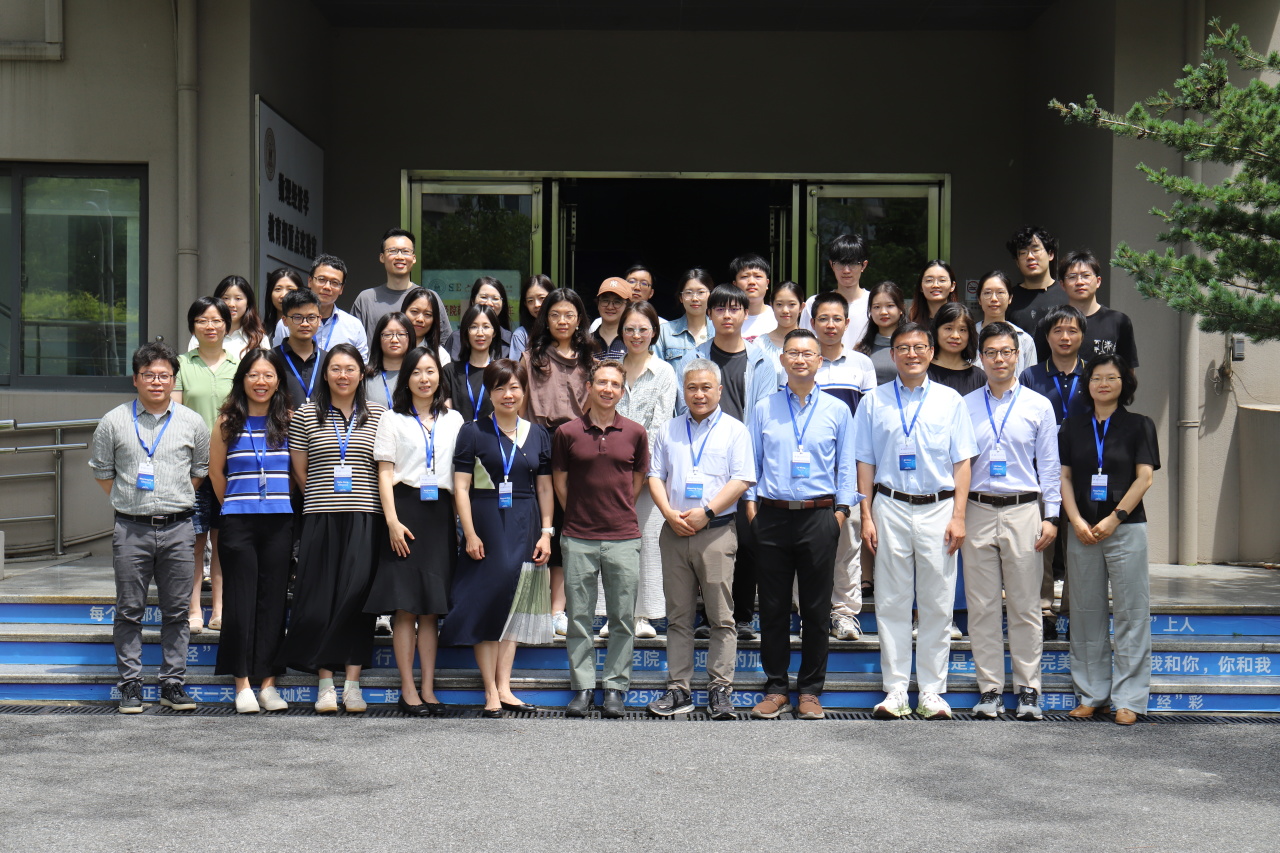
The 2026 Shanghai Labor Workshop was successfully held at the School of Economics, Shanghai University of Finance and Economics on July 7, 2026. Bringing together renowned labor economists and outstanding doctoral students from universities at home and abroad, including the University of Pennsylvania, Virginia Tech, the University of Hong Kong, Fudan University, Shanghai University of Finance and Economics, Shanghai University and ShanghaiTech University, this workshop aims to advance international collaboration and the development of labor economics research in China through high-level academic exchanges.
Professor Chen Yuanyuan, Deputy Dean of the School of Economics, Shanghai University of Finance and Economics, delivered the opening address. Professor Chen introduced the school’s achievements in academic research and disciplinary construction in recent years, and emphasized the great significance of the workshop for promoting labor economics research and academic communication. She hoped that the exchanges would broaden participants’ research horizons and strengthen academic cooperation between scholars from China and overseas.
Professor Hanming Fang from the University of Pennsylvania presented the paper entitled Generative AI and the Pre-Hire Labor Market: Evidence from a Chinese Job Matching Platform. Focusing on the impacts of generative AI shocks on the pre-hire labor market, this study notes that existing research mostly examines changes in firm-level productivity and labor demand, while paying insufficient attention to market responses before job seekers are hired. Using data from a Chinese job-matching platform and adopting a difference-in-differences design combining occupation-level AI exposure and the launch of ChatGPT, the paper investigates the effects of LLM shocks on job postings, wages, non-wage benefits, job requirements and callback rates. It finds that AI shocks generally reduce labor demand, raise requirements for high-human-capital jobs, and impose more pronounced adverse effects on low-human-capital job seekers. The study also highlights that regional labor regulatory environments serve as a buffer, offering important implications for understanding employment structural adjustments and policy responses amid AI technology diffusion.
Professor Le Wang from Virginia Tech delivered the presentation Economics and Econometrics of Intergenerational Mobility. Centered on the economic meaning, econometric methods and policy relevance of intergenerational mobility, the study systematically reviews traditional measurement approaches such as intergenerational income elasticity and rank regression, and thoroughly discusses their limitations stemming from linearity assumptions, income measurement and group heterogeneity. On this basis, it proposes a new measurement framework for intergenerational mobility integrating nonparametric methods, social welfare functions and distributional perspectives, stressing that mobility evaluation should fully incorporate social concerns and policy objectives for different groups. Further using PSID data, the paper demonstrates how different measurement approaches shape empirical outcomes, providing new research insights for understanding income transmission mechanisms and advancing equal opportunity.
Professor Naijia Guo from the University of Hong Kong presented The DNA of Enterprise: Genetic Endowments, Entrepreneurship and Intergenerational Mobility. Drawing on the UK Understanding Society (UKHLS) and National Child Development Study (NCDS) datasets, together with polygenic scores linked to educational attainment and risk tolerance, the study builds a general equilibrium OLG model incorporating genetic transmission, gene-environment interactions and occupation-specific productivity differences. It examines how genetic endowments shape individuals’ entrepreneurial choices and further affect intergenerational mobility and wealth distribution. The results show that PGS_EA (polygenic score for educational attainment) mainly influences wage income and entrepreneurial entry, whereas PGS_RT (polygenic score for risk tolerance) exerts a more significant effect on entrepreneurial performance. Through policy simulations, the study also compares collateral-based credit financing with capital allocation based on entrepreneurial ability, showing that the latter improves macroeconomic efficiency and fosters intergenerational mobility yet may widen income and wealth inequality.
Professor Chen Yuanyuan from Shanghai University of Finance and Economics gave the talk Cultural Diversity, Social Integration, and Child Development. The study distinguishes two key dimensions of cultural diversity — fractionalization and polarization. Using unique data from random class assignment in Shanghai primary schools, it identifies their causal effects on children’s social integration. The results show that fractionalization promotes cross-cultural friendships and openness among children, while polarization weakens intergroup integration and exacerbates externalizing behavioral problems. These effects operate mainly through the salience of social identities and are moderated by children’s prior exposure to multicultural environments and institutional features of schools.
Professor Feng Huang from Shanghai University of Finance and Economics presented Working Longer with AI? The Dynamic Intensive Margin Effects of Generative AI Shocks. This study investigates the dynamic impacts of generative AI in China on workers’ working hours, wages and task structures. It finds that the early ChatGPT shock did not generate clear changes in working hours, yet after the domestic diffusion of generative AI, workers in highly exposed occupations experienced significant rises in weekly working hours without corresponding increases in monthly wages, and hourly wages declined. Further analyses reveal that the rise in working hours concentrates among workers with room for hour expansion, informal employees and workers in market-oriented employment settings. Combined with surveys on generative AI usage, the evidence suggests that highly exposed workers are more likely to adopt AI at work, save time and take on more complex tasks. This provides a mechanism explaining how productivity gains from generative AI translate into task expansion and work reorganization. The research seeks to reinterpret how the productivity dividend of generative AI is distributed across the labor market from the perspective of dynamic labor supply and job quality.
Professor Zibin Huang from Shanghai University of Finance and Economics delivered the presentation Defensive Innovation: Technological Rivalry and College Major Choice. Using national college admission data and large-scale online recruitment data from 2017 to 2020, the study documents an unexpected effect of U.S. tariffs against China: majors more severely affected by the tariffs saw larger rises in admission cutoff scores and enrollment scales, a pattern concentrated in STEM majors at key national universities. The paper argues that trade policies designed to contain China’s high-tech industries have instead accelerated the concentration of top talents toward technological self-reliance, producing outcomes contrary to the original policy intent. The underlying channel is “defensive innovation”: facing technological blockades, Chinese firms substantially increase demand for R&D positions and raise corresponding wage premiums, while the government expands enrollment in relevant majors. Shifts in labor market returns guide high-achieving students into high-tech fields.
Professor Sai Luo from Shanghai University of Finance and Economics presented Female Role Models and Selection into the Public Sector: Evidence from Linked Gaokao-Payroll Data. Drawing on tracking data of high school graduates in Beijing, the study reveals that gender role models exert significantly heterogeneous gender-specific effects on students’ major and career choices. It finds that the presence of high-achieving female role models within the same school substantially raises the probability that female students in the next cohort enter the public sector (especially education and health care) and choose relevant college majors. It offers novel quantitative evidence for understanding social interaction factors behind gendered occupational choices in the Chinese context.
With this, the 2026 Shanghai Labor Workshop concluded successfully. The workshop provides a valuable exchange platform for labor economists, further expands channels for cross-border academic dialogue, and injects fresh momentum into the international development of labor economics research in China.