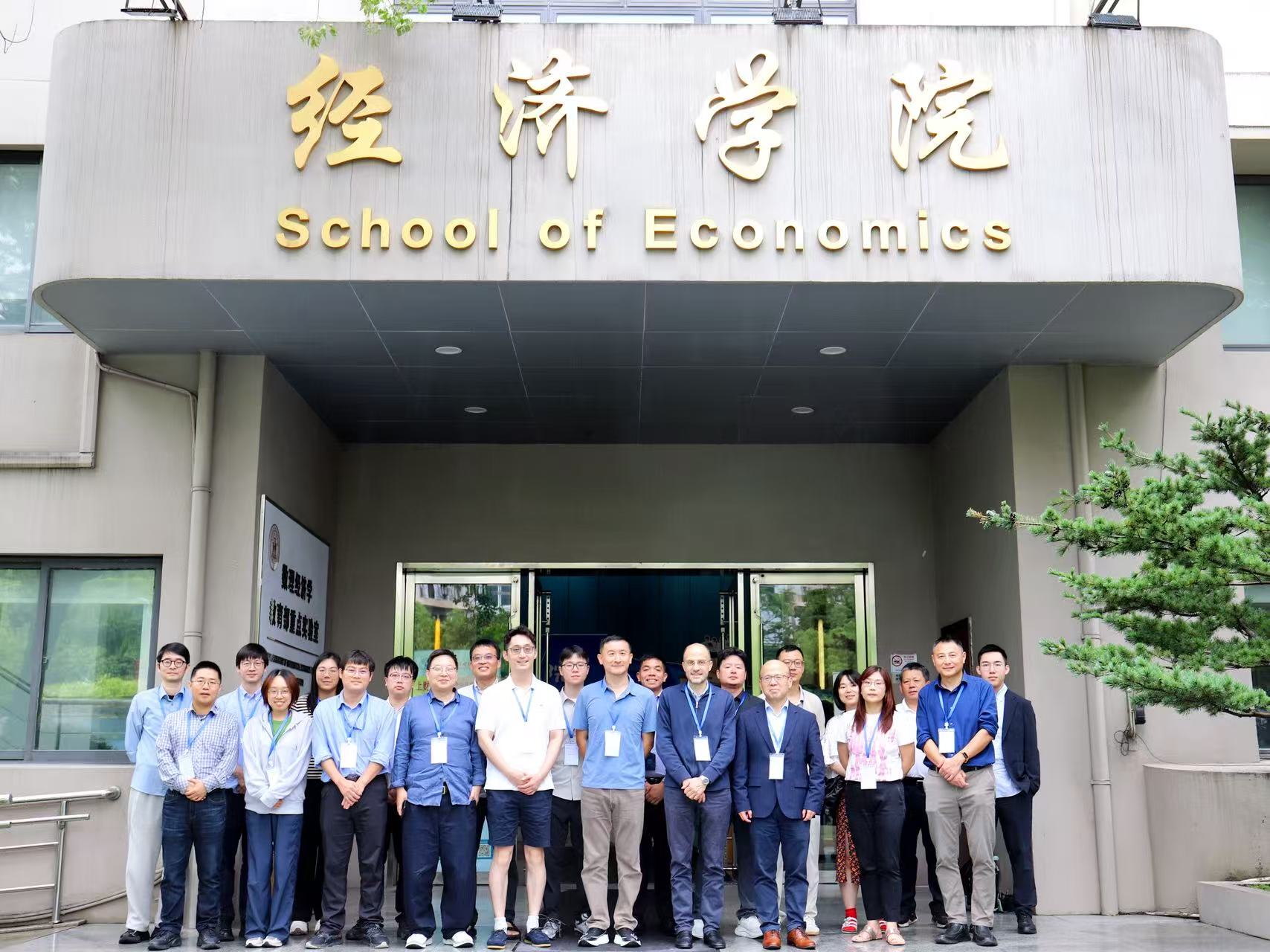
The 2026 Shanghai Macroeconomics Workshop was successfully held at the School of Economics, Shanghai University of Finance and Economics on June 23–24, 2026. Bringing together macroeconomics scholars and outstanding doctoral students from institutions worldwide including the International Monetary Fund, the University of Oxford, the University of Connecticut, Emory University, the University of Hong Kong, the Chinese University of Hong Kong, City University of Hong Kong, Tsinghua University, Peking University, Fudan University, Renmin University of China and Central University of Finance and Economics, the workshop aims to advance collaboration and development in macroeconomic research through high-level academic exchange.
PART.01 Morning, June 23
Professor Chen Yuanyuan, Deputy Dean of the School of Economics, Shanghai University of Finance and Economics, delivered the opening address. She extended a warm welcome to scholars from all regions and emphasized the workshop’s significance for advancing macroeconomic research and academic communication. She expressed the hope that the exchanges would inspire participants and strengthen academic collaboration.
The workshop invited Professor Francesco Zanetti from the University of Oxford to deliver the keynote speech entitled Charting the Uncharted: The (Un)Intended Consequences of Oil Sanctions.
Professor Kaiji Chen from Emory University gave the keynote speech titled A Tradeoff between Monetary Policy Transmission and Systemic Risk.
Senior Economist Hui He from the International Monetary Fund presented Stablecoins and Macroeconomic Stability: A DSGE Investigation. Tenured Associate Professor Jingyi Zhang from Shanghai University of Finance and Economics presented Regime Switching in Credit Market in China.
PART.02 Afternoon, June 23
Parallel Session: Technology and Industrial Policy
Associate Professor Lijun Zhu from Peking University, Assistant Professor Guanliang Hu from City University of Hong Kong, Professor Xuewen Liu from the University of Hong Kong, and Assistant Professor Sifan Xue from Peking University presented papers entitled Capability, Consumption and Competition: The Evolution of China’s Electric Vehicles Industry, Intellectual Property Financing, Innovation, and Aggregate Productivity, When to Push? Market Forces, Government Intervention, and the Optimal Timing of Industrial Policy, and Short-Run Boom, Long-Run Bust: The Dynamic Impact of U.S. Semiconductor Export Controls, respectively.
Parallel Session: Labor and Spatial Equilibrium
PhD candidate Weikang Hu from the Chinese University of Hong Kong, Associate Professor Linyi Cao from Shanghai University of Finance and Economics, Associate Professor Xican Xi from Fudan University, and Professor Xue Qiao from Renmin University of China presented Who Gets to Live in the Productive City? Family Transfers, Housing Costs, and Spatial Sorting, Unequal Transition: The Widening Wealth Gap amidst China’s Rapid Growth, Spatial Population Dynamics: Fertility, Migration, and Policies, and Effects of the “New Occupational Injury Insurance” Pilot Program on Gig Employment, Algorithmic Intensity, and Social Welfare: A General Equilibrium Analysis.
PART.03 Morning, June 24
Assistant Professor Minghao Li from Peking University presented How do Stimulus Policies Move Firms' Expectations? Evidence from Chinese Micro and Small Enterprises. PhD candidate Wenyan Wang from Central University of Finance and Economics presented Bank Expansion: Corporate Acquisitions as Catalysts.
PART.04 Afternoon, June 24
Professor Kai Zhao from the University of Connecticut, Assistant Professor Jinxiang Yu from Shanghai University of Finance and Economics, Assistant Professor Rusi Yan from Central University of Finance and Economics, and PhD candidate Zanhui Liu from Tsinghua University presented Financial Frictions and the Optimal Quantity of Government Debt, Entrepreneurship and Credit Crunch, Uncovering Frictions to Long-Term Borrowing, and A Theory of International Conditional Lending.
With this, the 2026 Shanghai Macroeconomics Workshop concluded successfully. The conference provided a valuable exchange platform for macroeconomics researchers, further expanded channels for cross-border academic dialogue, and injected new momentum into the internationalization of China’s macroeconomic research.