The workshop entitled “China’s Economy and Econometrics toward the AI Era — 2026 Shanghai Advanced Econometrics Workshop” was successfully held at the School of Economics, Shanghai University of Finance and Economics, on June 20–21, 2026. Co-hosted by the School of Economics of Shanghai University of Finance and Economics and the Key Laboratory of Mathematical Economics (SUFE), Ministry of Education, the conference facilitated in-depth exchanges and discussions on frontier theories and applications of econometrics in the artificial intelligence era. It attracted experts and scholars from universities at home and abroad, including Peking University, Fudan University, Shanghai Jiao Tong University, Zhejiang University, Renmin University of China, Wuhan University, Xiamen University, the University of Hong Kong, the Chinese University of Hong Kong (Shenzhen), and Brown University in the United States.
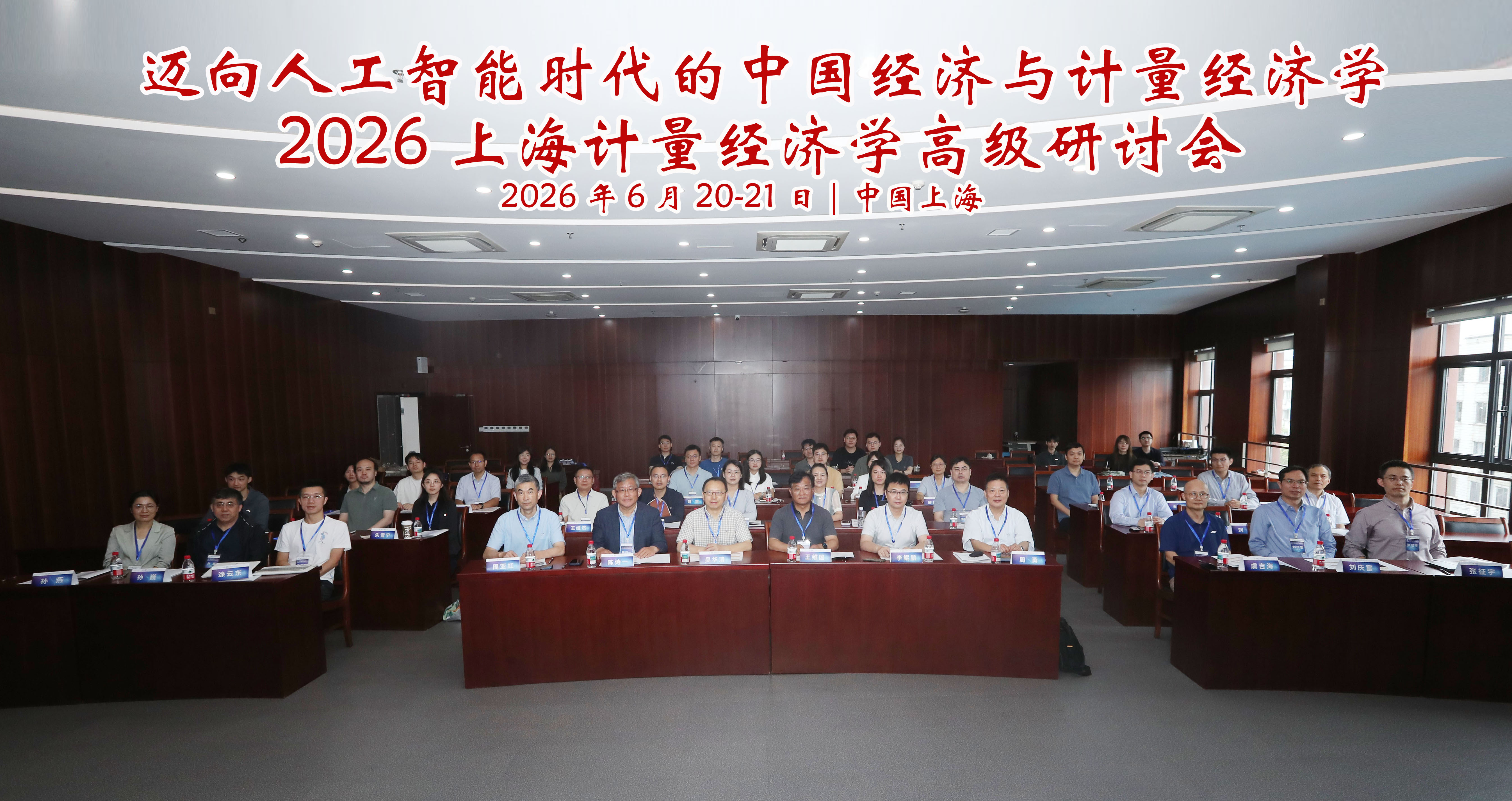
Six parallel sessions were arranged at the conference, covering network econometrics, big data and artificial intelligence, financial econometrics, applied econometrics, causal inference, time series analysis and other research directions.
Opening Ceremony 01
The opening ceremony was presided over by Professor Zhang Zhengyu, Chair of the Econometrics Department at Shanghai University of Finance and Economics.
Tenured Professor Zhou Yahong, Dean of the School of Economics, Shanghai University of Finance and Economics, delivered the opening address. He extended a warm welcome to all participating scholars and noted that this workshop aims to build a high-level academic exchange platform, foster methodological innovation in econometrics and interdisciplinary collaboration, and advance frontier research and practical development in relevant fields.
Morning, June 20 02
Keynote Speeches
Professor Wang Weiguo from Dongbei University of Finance and Economics presented his latest working paper The Elderly Welfare Effects of Childcare Services under the Background of Delayed Retirement Policy, evaluating the impact mechanism of such policy combinations on elderly welfare.
Professor Chen Shiyi from Fudan University discussed The Dual Emission Reduction Effects of Optimized Land Allocation, sharing how the allocation of land resources can generate dual emission reduction outcomes simultaneously.
Professor Li Kunpeng from Capital University of Economics and Business presented the paper entitled On the Endogeneity of Spatial Weights Matrix, focusing on estimation when the spatial weights matrix is endogenous.
Parallel Sessions
Professor Qu Xi from Shanghai Jiao Tong University, Associate Professor Sheng Shuyang from the Chinese University of Hong Kong (Shenzhen), and Professor Han Xiaoyi from Xiamen University delivered presentations on Spatial Autoregressive Models with Outcome Generated Spatial Weights, Weak Identification in General Peer Effect Models, and Identifying Time-Varying Latent Grouped Heterogeneity in Spatial Dynamic Panels: A Nonparametric Bayesian Approach, respectively.
Professor Zheng Tingguo from Xiamen University, Professor Liu Qingfu from Fudan University, and Associate Professor Luo Ye from the University of Hong Kong presented papers on Nowcasting GDP Growth in an Ever-Changing World, Let Tables Talk: Auditing and Enhancing Corporate Narratives with LLMs, and Inference Net: Empirical Studies in Business Related Fields and AI replicability.
Afternoon, June 20 03
Keynote Speeches
Professor Tu Yundong from Peking University gave a talk entitled Characteristic-Driven One-Factor Model for the Cross-Section of Stock Returns. The study constructs a unified one-factor model driven by characteristics to explain stock returns.
Professor Chen Songnian from Zhejiang University presented Quantile Selection Models, introducing new alternative estimators that address identification and estimation challenges under weak instrumental variable signals.
Professor Zhou Yong from East China Normal University delivered the speech Enhancements of Communication-Efficient Distributed Statistical Inference and Its Privacy Preservation, discussing how to achieve low communication cost, high estimation precision and strong privacy protection within a distributed framework.
Parallel Sessions
Professor Wang Xia from Renmin University of China, Professor Liu Cheng from Wuhan University, Associate Professor Wang Dan from NYU Shanghai, and Professor Li Haiqi from Hunan University presented on High-Dimensional Mixed-Frequency Factor Models with Temporal Aggregation, High-Dimensional Multivariate Realized Volatility Forecasting with Community Network Structure, Estimation of Rough Leverage Effect, and Sparse Grouped Heterogeneity in Panel Data: A Penalized K-Means Approach.
Professor Zhou Xianbo from Sun Yat-sen University, Professor Sun Wei from Jilin University, Professor Xiao Qiang from Lanzhou University of Finance and Economics, and Associate Researcher Ji Yuanyuan from Shanghai Academy of Social Sciences delivered presentations on Macroeconomic Upturn and the Rise in Household Consumption Propensity: Evidence and Mechanism, Consumption Effects of Local Government Expectation Guidance — Empirical Analysis Based on Press Conference Corpus, Measurement, Source Exploration and Consumption Effect Analysis of Inflation Uncertainty in China, and Artificial Intelligence and Firms’ Technological Catch-Up: Internal Incentives and External Linkages.
Dean’s Forum: Impacts and Challenges of AI for Economic Research
A special Dean’s Forum was held for the conference, featuring themed discussions on “Impacts of Artificial Intelligence on Economic Research and Solutions”. From the perspectives of methodological innovation, transformation of data structures and shifts in empirical research paradigms, participating scholars explored emerging opportunities and challenges facing econometrics in the AI era.
Morning, June 21 04
Keynote Speeches
The conference specially invited Professor Toru Kitagawa from Brown University to present his working paper Who With Whom? Learning Optimal Matching Policies. He proposed an entropy-regularized empirical optimal transport learning method to learn welfare-optimal matching rules from observable characteristics in two-sided matching problems.
Professor Yu Jihai from Peking University delivered a talk entitled Dyadic Spatial Dynamic Panel Data Models with Fixed Effects: A GMM Approach. He developed a general dyadic spatial dynamic panel model and systematically discussed the elimination and inference of multi-dimensional fixed effects.
Parallel Sessions
Associate Researcher Tan Liming from Nanjing University, Professor Zhang Zhengyu from Shanghai University of Finance and Economics, and Professor Chen Qiang from Shandong University presented on Clustering for Quantile Panel Data Model with Interactive Fixed Effects, Learning optimal infinitesimal nudge via quantile partial effects, and The Myth of Bad Controls.
Associate Professor Zhu Xuening from Fudan University, Professor Wu Jilin from Xiamen University, and Professor Lin Wei from University of International Business and Economics delivered presentations on Model-Xt Knockoffs: Controlling the False Discovery Rate in High Dimensional Time Series, Testing Quantile Predictability with a Persistent Regressor, and Least Hausdorff distance regression for interval-valued data.
With this, the workshop entitled “China’s Economy and Econometrics toward the AI Era — 2026 Shanghai Advanced Econometrics Workshop” concluded successfully. The conference not only showcased the latest advances in econometrics, but also further promoted the integration of artificial intelligence and economic methodologies, injecting new momentum into the development of econometrics in China.
Going forward, relying on its disciplinary strengths and platform resources, the School of Economics of Shanghai University of Finance and Economics will continue to facilitate high-level international academic exchanges and support theoretical innovation and practical development of economics in China.