Editor’s Note
With the support of the university and the school, the School of Economics at Shanghai University of Finance and Economics is building the branded academic series Statecraft Economics · Frontiers of Political Economy. Relying on key academic initiatives including academic papers, monographs, seminars, lectures and research reports, the school further expands new room for the development of its political economy discipline. On the new journey toward Chinese‑style modernization, it contributes the insights and strengths of SUFE’s political economy discipline to the construction of the theoretical, knowledge and discourse systems of Chinese economics.
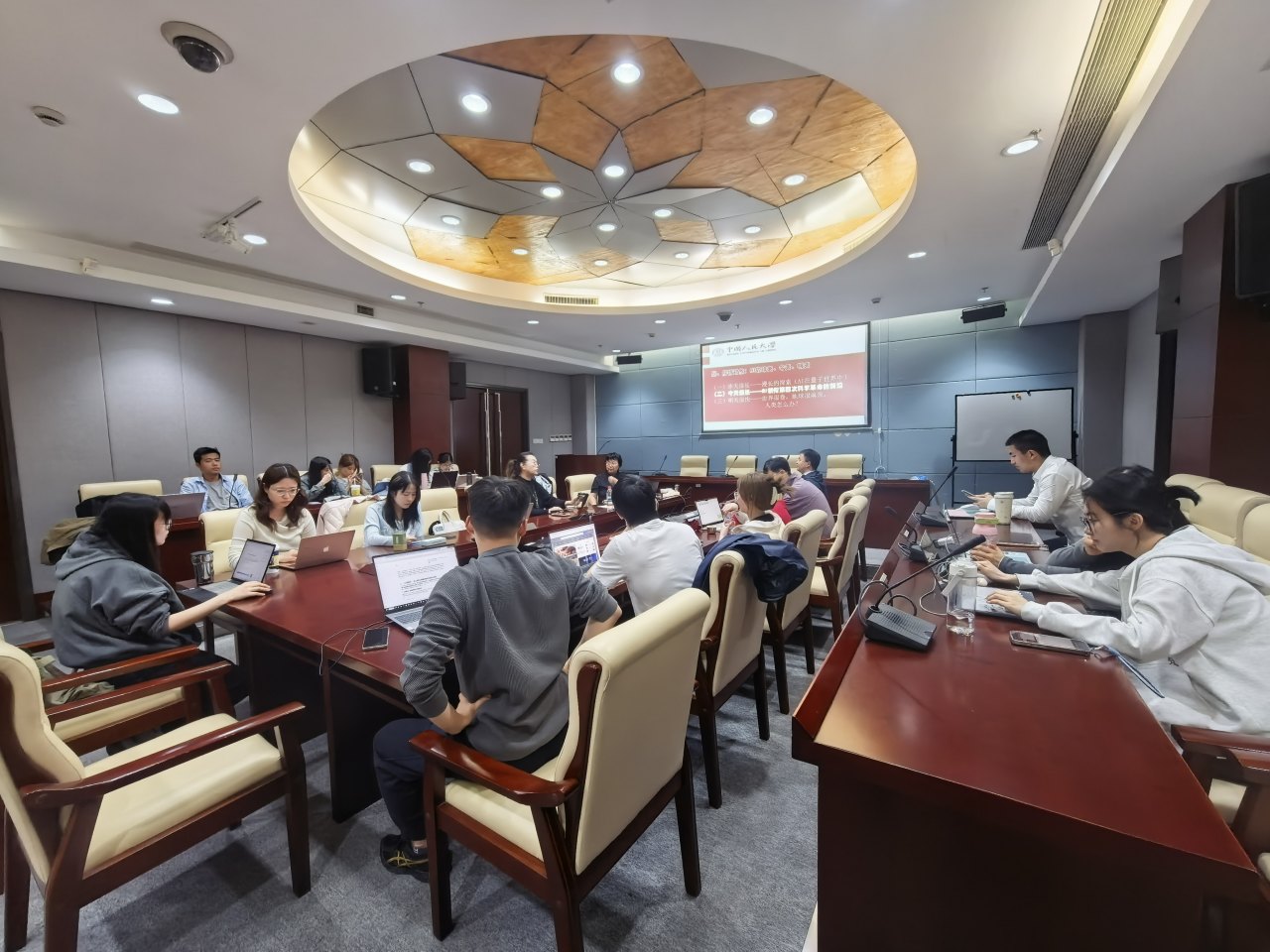
To systematically sort out the evolutionary context of artificial intelligence and grasp its future development trajectory from the perspective of basic research, the Department of Political Economy, School of Economics, Shanghai University of Finance and Economics, invited Professor Yang Zhi, Doctoral Supervisor from the School of Economics, Renmin University of China, to deliver a special lecture titled The Past, Present and Future Development Trends of Artificial Intelligence: From the Perspective of Basic Research on May 8, 2026. The lecture was hosted by Professor Yan Jinqiang from the School of Economics and attended by all postgraduate students of the Department of Political Economy.
01 Research on AI Should Adopt the Perspective of “Basic Research”
Professor Yang Zhi pointed out that social sciences, especially Marxist political economy, are undergoing profound changes triggered by artificial intelligence. Grasping the evolutionary laws of natural sciences and conducting in-depth basic research is critical for political economy to deepen its academic foundation, consolidate its theoretical underpinnings and keep pace with the changes of the times.
She elaborated on this view from three dimensions. First, regarding the connotation of basic research: General Secretary Xi Jinping presided over a symposium on strengthening basic research in Shanghai and delivered an important speech, stressing that “Basic research is the source of the entire scientific system and the master controller for all technical problems”. Second, regarding the value of basic research amid the AI revolution: against the backdrop of accelerated breakthroughs in the new round of scientific and technological revolution and industrial transformation, global scientific and technological competition is increasingly concentrated on frontier basic fields, and original and disruptive innovation is growing in importance. Third, regarding practical pathways to strengthen basic research in the future: it is necessary to coordinate and optimize the layout guided by the “Four Orientations”, promote coordinated development of basic and applied sciences, and actively integrate into the global innovation network. This mission falls mainly on the younger generation equipped with the scientific spirit and original innovation capacity.
02 Understanding AI Must Trace Back to the Source of “Basic Science”
Professor Yang Zhi systematically reviewed the evolutionary history of the relationship between science and technology. She noted that scientific exploration is a uniquely human activity. It explores new phenomena, laws and truths with a questioning and critical attitude and shapes people’s scientific literacy and wisdom, with basic science as its core foundation.
Against the modern backdrop of continuous disciplinary differentiation and integration, frontier areas in basic science break classical cognition and adopt new methodologies. Technical science serves as the intermediate category that inherits basic theories and translates them into real productive forces, extending from fundamental principles toward practical applications. Within the whole evolutionary system of science and technology, artificial intelligence emerged after long-term theoretical accumulation. As the core of the fourth scientific and technological revolution, artificial intelligence is underpinned by matter, energy and information, connects the digital, physical and biological spheres, and represents an emerging interdisciplinary technological form centered on information processing. Based on this evolutionary logic, she emphasized that whether dealing with informatization, digitalization or intelligentization issues, we must combine the precision of natural sciences with the institutional analysis of social sciences under the guidance of Marxist scientific methodology.
03 Analyzing AI Requires a “Yesterday-Today-Tomorrow” Mindset
Professor Yang Zhi argued that artificial intelligence is an extension of human intelligence and constitutes a genuine general-purpose technological revolution. Following the logic of the history of science, she divided AI development into three stages: the long yesterday, the blazing today and the promising tomorrow. Looking back, AI is rooted in the long evolution of human science, ranging from the germination of ancient science and the modern scientific revolution to the development of contemporary science. At present, as a core driving force of the fourth scientific and technological revolution, AI is crossing a critical threshold, deeply integrating with life sciences and quantum technologies, taking computing power as key infrastructure, and reshaping production, livelihood, consumption, education and other fields. Looking ahead, the ultimate goal of AI is to liberate human intelligence and productive forces. Its form will gradually evolve from computational intelligence and perceptual intelligence to cognitive intelligence, and explore from weak artificial intelligence toward strong artificial intelligence and superintelligence. While envisioning bright prospects, we must also pay attention to humanistic and ethical issues brought by AI.
At the end of the lecture, faculty and students exchanged views with Professor Yang Zhi on topics including the current status of integration between digital and real economy and its links with classic texts, as well as institutional and educational cost-sharing for AI development. Professor Yang Zhi noted that investment costs for relevant institutional construction and personnel capacity transformation should be shared by multiple stakeholders. Education and training can help workers adapt to new demands. Meanwhile, institutions should be optimized and adjusted in response to changes in productive forces to accommodate new technologies and new business forms and balance various contradictions and problems arising in the development process.
In his concluding remarks, Professor Yan Jinqiang stated that Professor Yang Zhi delivered an in-depth lecture centered on the past, present and future trends of artificial intelligence from the perspective of basic research. With profound scholarship and rigorous logic, she unpacked core connotations layer by layer, offering highly inspiring ideas for faculty and students to clarify the evolutionary trajectory of AI, grasp its future direction, advance interdisciplinary knowledge integration and pursue academic innovation.