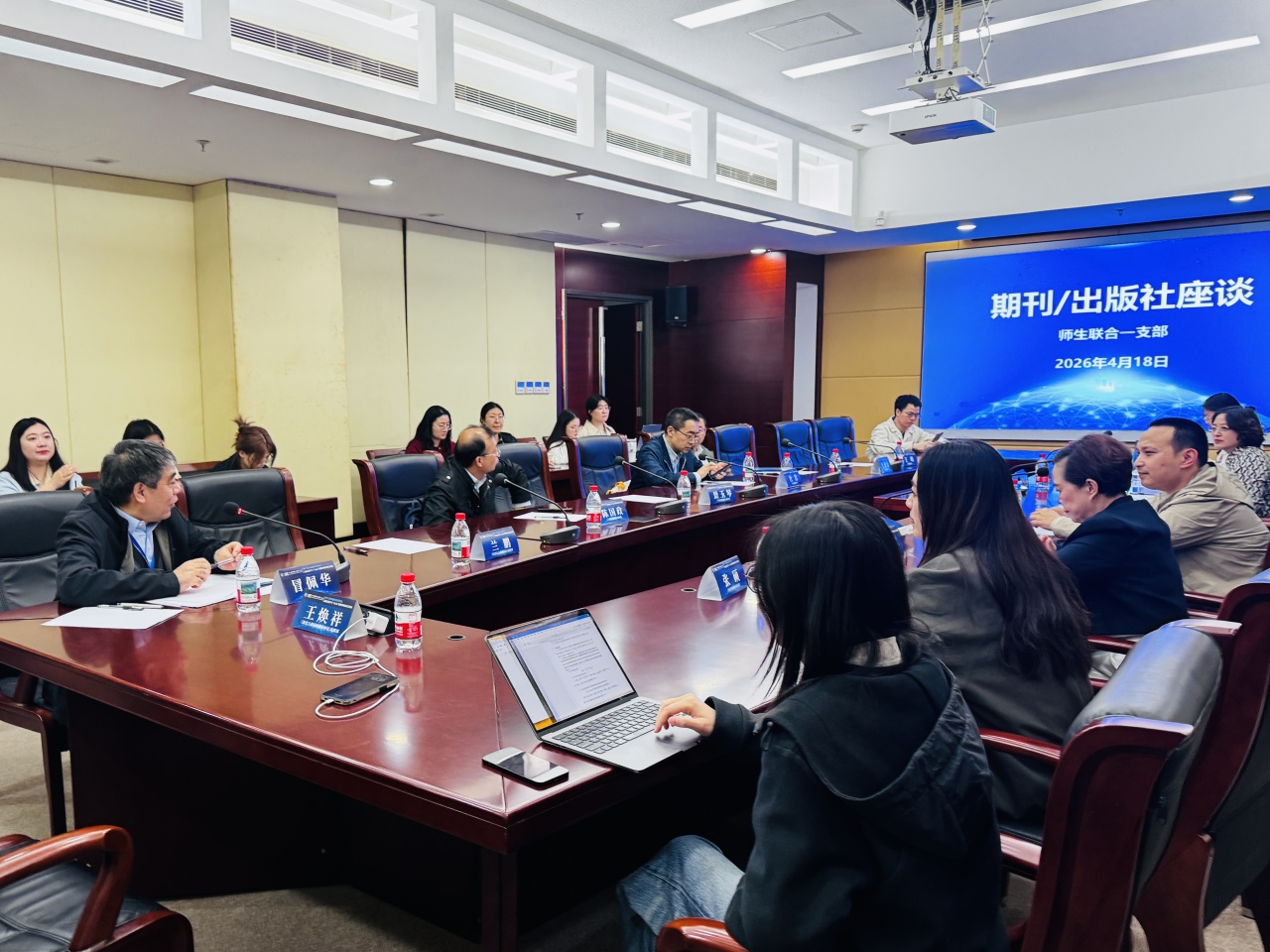
To fully implement the requirement of “Delivering Practical Services for Faculty and Students” and build a bridge linking high-standard academic publishing to the research growth of faculty and students, the “Doctor’s Talk” event — the journal forum titled Joining Hands with Prestigious Journals and Publishers to Discuss Academic Frontiers — hosted by the First Joint Party Branch of Faculty and Students of the School of Economics was successfully held in Meeting Room 710 of the School of Economics on April 18, 2026. The forum invited senior editors from eight well-known domestic journals, namely Academic Monthly, Economic Perspectives, Social Sciences, Shanghai Economic Review, Economic Review, Humanities Journal, Research on Financial and Economic Issues and Social Sciences Digest, to engage in face-to-face exchanges with faculty and students. In-depth discussions were carried out around journal selection priorities, paper writing standards and submission norms. The activity was chaired by Professor Mao Peihua, Deputy Dean of the School of Economics, with participation of some postgraduate students and young faculty Party members.
At the opening of the event, Professor Mao Peihua briefly introduced the background of the forum. He noted that academic publication constitutes a vital part of doctoral training. Direct dialogue with editors from high-level journals and publishing houses helps students accurately grasp academic frontiers, standardize research practices and improve submission acceptance rates. This activity represents an organic integration of the branded “Doctor’s Talk” series and the themed practical initiative “Delivering Practical Services for Faculty and Students” undertaken by the First Joint Party Branch of Faculty and Students.
Thereafter, the eight senior editors shared their insights in sequence.
Ms. Shen Min from the editorial department of Academic Monthly emphasized rigorous scholarship, profound thinking and theoretical accumulation. She reminded young researchers that hot-topic submissions face fierce competition and may easily get overlooked. Instead, scholars should conduct in-depth research in competitive fields, prioritize originality and big-picture research awareness, and encourage the combination of quantitative and qualitative analysis.
Ms. Zhang Shuo from the editorial department of Economic Perspectives introduced its three regular columns: Socialist Political Economy with Chinese Characteristics, empirical papers, and reviews of theoretical research developments. She specifically pointed out that review articles must feature theoretical depth rather than simple literature listing, and reminded authors to complete all personal information and submit manuscripts via the official website of the Institute of Economics, Chinese Academy of Social Sciences.
Mr. Zhang Yichen from the editorial department of Social Sciences stated that the journal is shifting from selecting outstanding individual manuscripts to theme-based and special-issue commissioning, and striving to break disciplinary boundaries. He suggested authors keep track of new formulations in policy documents to seize first-mover advantages by responding promptly, and pay close attention to policy updates ahead of major national conferences.
Mr. Chen Guozheng from the editorial department of Shanghai Economic Review, drawing on his review experience, stressed the importance of attractive research topics and high-quality abstracts. He noted that references should be up-to-date and datasets not overly outdated, and recommended student-authored papers to be co-written with supervisors to enhance credibility.
Mr. Du Lei, Deputy Director of the editorial department of Economic Review, introduced that the journal prioritizes theoretical research, rural economics and institutional studies. He encouraged young scholars not to blindly chase hot topics and to explore “competitive niche topics”, while also advising advance research planning on emerging themes such as new-quality productive forces.
Researcher Tian Hua from the editorial department of Social Sciences Digest presented an overview of this comprehensive journal. Its recent priority topics in economics include artificial intelligence and the digital economy. She advised authors to study the journal’s style carefully and format manuscripts in line with its requirements before submission.
Ms. Sun Yan, Director of the editorial department of Research on Financial and Economic Issues, broke down writing norms for empirical papers. She explained that the title, abstract, research theme and marginal contribution are decisive at the initial review stage. The research motivation section should cover research background, literature review and contribution statement, and policy recommendations must be tightly anchored to research findings instead of being vague. Recent hot themes include new-quality productive forces, digital economy and financial reform.
Mr. Niu Zedong from the editorial department of Humanities Journal introduced this comprehensive monthly journal, which values academic rigor, originality and intellectual depth. Priority columns include the Belt and Road Initiative, the three systems of philosophy and social sciences with Chinese characteristics, and Xi Jinping Thought on Socialism with Chinese Characteristics for a New Era. The journal particularly welcomes theoretical papers addressing practical issues in China.
Students listened attentively and took detailed notes, and reached out to editors after the session. Many participants commented that the forum clarified their understanding of journal review workflows, editorial preferences and writing standards, which would greatly facilitate their future academic publishing.
In his concluding remarks, Professor Mao Peihua remarked that the forum offered a precious platform for direct dialogue between faculty, students and the academic publishing community. He urged doctoral students and young Party members to take this opportunity to attach greater importance to topic quality, academic norms and real-world relevance in paper writing and research, and to “write dissertations on the land of the motherland”. The First Joint Party Branch of Faculty and Students of the School of Economics will continue to uphold the mission of serving faculty and students, and launch more high-quality academic exchange activities tailored to the developmental needs of doctoral students.