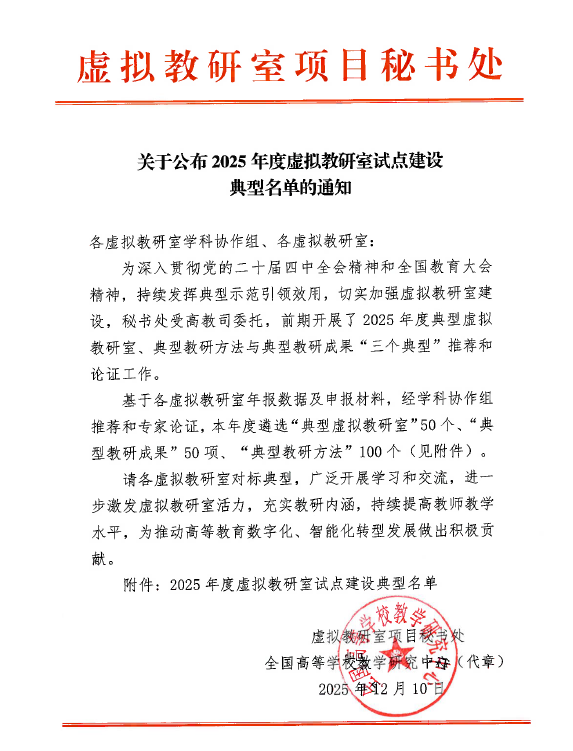
On December 11, the Secretariat of the Virtual Teaching and Research Section Project released the 2025 Model List for Pilot Construction of Virtual Teaching and Research Sections. The “101 Plan” Virtual Teaching and Research Section for the Econometrics Course was recognized as a Model Virtual Teaching and Research Section, one of only 50 selected nationwide.
Approved in November 2023 as part of the third batch of MOE virtual teaching and research section pilots, this initiative is co-led by Professor Hong Yongmiao (Xiamen University / University of Chinese Academy of Sciences) and Professor Zhou Yahong (Shanghai University of Finance and Economics). It brings together outstanding faculty from six universities and research institutions: the University of Chinese Academy of Sciences, Xiamen University, Shanghai University of Finance and Economics, Dongbei University of Finance and Economics, the Shanghai Academy of Social Sciences and Wuhan University. The section now has 65 members across 43 institutions in 21 provincial-level regions nationwide. It operates a dual-collaboration mechanism linking “elite universities and local institutions” as well as “research platforms and enterprises”, actively extending high-quality educational resources to central and western China.
Centered on compiling and promoting the core Econometrics textbook under the “101 Plan”, the teaching section integrates ideological and political guidance with disciplinary instruction. It has delivered a stream of outcomes in curriculum development, textbook compilation and disciplinary competitions, alongside knowledge-graph construction, independent software development, high-level academic exchanges and faculty training. A hallmark of its innovation is AI-enabled teaching, forming a full workflow from knowledge graphs to domain-specific large models. Its self-developed teaching software E-Suanchou and AI teaching assistants are widely deployed in classrooms. The in-house China Financial Market Large Model and Fin-R1 reasoning model bridge frontier research and industrial applications. In addition, the team has pioneered interdisciplinary programmes such as AI Economics, AI Finance, Economics + Data Science and Finance + Data Science. This innovative model for cultivating compound talents offers replicable experience for the New Liberal Arts initiative and charts a development path featuring solid foundational training, intelligent empowerment and interdisciplinary integration.
The MOE “101 Plan”
The MOE “101 Plan” focuses on undergraduate education in basic disciplines. Originally proposed by John Hopcroft, Turing Award laureate, it is a major education reform initiative led by the Ministry of Education. At the end of 2022, the MOE launched the “101 Plan” pilot reform for undergraduate teaching in foundational fields including mathematics, physics, chemistry, biology, basic medicine, Chinese materia medica, economics and philosophy. Peking University and Professor Justin Yifu Lin, Director of the Peking University Institute of New Structural Economics, serve as the lead host university and chief expert for the economics track of the “101 Plan”. They coordinate a consortium of universities covering all 20 national Economics Top-Talent Training Base 2.0 sites to build core economics courses, textbooks, practical projects and high-caliber teaching teams. For the flagship core course Econometrics under the economics “101 Plan”, Hong Yongmiao and Zhou Yahong act as co-leads, with the University of Chinese Academy of Sciences, Xiamen University and Shanghai University of Finance and Economics as co-host universities, and Dongbei University of Finance and Economics, the Shanghai Academy of Social Sciences, Wuhan University and others as partner institutions.