On June 24–25, 2025, the 2025 Shanghai Econometrics Workshop: Network and Spatial Econometrics, jointly hosted by the School of Economics at Shanghai University of Finance and Economics and the Key Laboratory of Mathematical Economics of the Ministry of Education, was successfully held at Shanghai University of Finance and Economics. The workshop brought together scholars and doctoral students from multiple universities and research institutions at home and abroad, including the Massachusetts Institute of Technology, Purdue University, the University of Wisconsin–Madison, the University of Warwick in the United Kingdom, as well as Peking University, Tsinghua University, Southeast University, Fudan University, Xiamen University, and Zhejiang University. It aimed to promote cooperation and development in econometric research through high-level academic exchange.
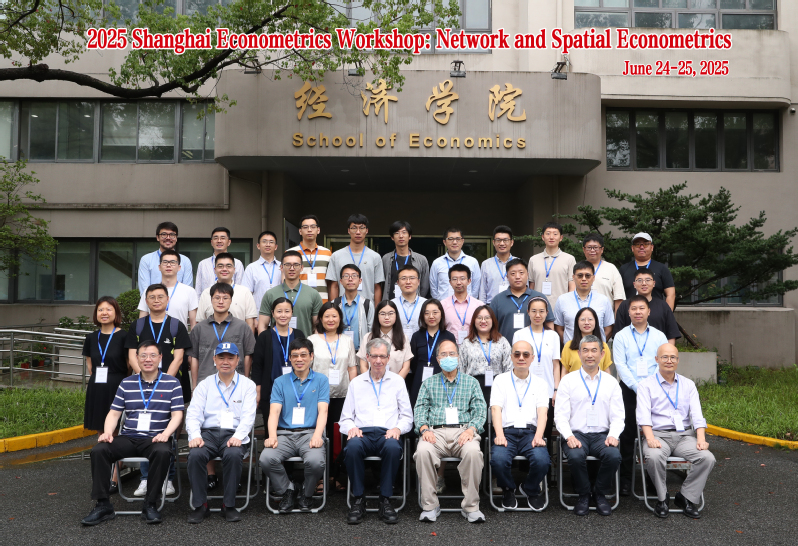
Opening Ceremony
At the opening ceremony, Professor Zhou Yahong, Dean of the School of Economics at Shanghai University of Finance and Economics, delivered a speech and extended a warm welcome to the participating scholars. He noted that this workshop would build a high-level exchange platform for scholars at home and abroad and promote innovation in econometric methods and interdisciplinary cooperation.
Keynote Reports
The workshop invited several renowned scholars from home and abroad to deliver keynote reports:
Professor Whitney Newey of the Massachusetts Institute of Technology spoke on the theme "Welfare Analysis in Dynamic Models," introducing new progress in welfare measurement in dynamic models by him and his co-authors. The report proposed a unified analytical framework covering parameters such as average welfare, marginal effects, and policy effects, and achieved more robust inference through dual representations and doubly robust representations. Professor Newey also presented methods for estimating value functions based on Lasso and neural networks, and applied them to a teacher attendance experiment in India, revealing the impact of dynamic incentive mechanisms on the welfare effects of education policy.
Professor Jin Jiashun of Southeast University, drawing on cutting-edge achievements in artificial intelligence, shared research titled "Counting Cycles with DeepSeek." This work solves high-complexity computational problems in network cycle counting through human-machine collaboration, can significantly improve the efficiency of large-scale network analysis, and demonstrates the application potential of artificial intelligence in statistics and data science research.
Professor Yong Bao of Purdue University, using the Airbnb platform as an example, presented the paper "Price Competition and Habit Persistence in the Airbnb Economy." Based on a Bayesian spatial dynamic panel Tobit model, the paper simultaneously characterizes the competition effects between neighboring listings and price stickiness.
Professor Chen Songnian of Zhejiang University shared work titled "Partial Identification of Quantile Selection Models," proposing the use of nonparametric copula methods to achieve more flexible partial identification under binary and truncated models. This research avoids overly strong distributional assumptions, can provide robust estimates and confidence intervals, and offers a new tool for causal inference under sample selection bias.
Associate Professor Chen Mingli of the University of Warwick presented the latest research findings "Coauthor and Citation Networks in Economics and Statistics." This work systematically analyzes collaboration patterns, author influence, and journal effects in top journals in economics and statistics over the past four decades.
The keynote reports were chaired by Associate Professor Zhang Hanghui, Associate Professor Yang Chao, and Associate Professor Yang Kai of Shanghai University of Finance and Economics.
Frontier Topic Discussions
The workshop established two thematic venues, "Network and Spatial Econometrics" and "Microeconometrics," covering multiple research frontier topics such as network modeling, spatial econometric models, causal inference, and policy evaluation.
Network and Spatial Econometrics
On the afternoon of June 24, Professor Li Yingxing of Xiamen University proposed a new method for modeling network regression using a "low-rank plus sparse" structure, which effectively reduces measurement error in the adjacency matrix and improves the accuracy of spillover effect estimation. Associate Professor Yang Chao of Shanghai University of Finance and Economics studied spatial autoregressive models with interval observations.
Associate Professor Zhu Xuening of Fudan University proposed a truncated and constrained Yule-Walker robust estimation method for dynamic spatial autoregressive models, achieving a convergence rate close to minimax optimal when dealing with heavy tails and weak sparsity structures. Associate Professor Sheng Shuyang of the Chinese University of Hong Kong (Shenzhen) proposed a new method for handling peer effects under endogenous group formation, and empirical evidence from Chilean high school data showed that failing to correct for selection bias would significantly overestimate peer effects. Associate Professor Yong Cai of the University of Wisconsin–Madison extended the framework of regression discontinuity design to simultaneously account for spillover effects between neighboring units, proposing a "local spillover regression" method that allows consistent estimation even in the presence of spillover effects. Assistant Professor Yang Zixin of Shanghai University of Finance and Economics proposed a nonparametric network vector autoregressive model to capture nonlinear network spillovers and momentum effects in network time series, and verified the effectiveness of its estimation and testing methods theoretically, through simulations, and empirically.
On the morning of June 25, Professor Shi Wei of Jinan University proposed a high-dimensional dynamic effect estimation method combining low-rank tensor autoregression with Neyman orthogonal moments, used to characterize linkage relationships in multilayer networks. Lecturer Meng Xiaoyu of Nankai University proposed a threshold spatial panel model with two-way fixed effects, developed adjusted maximum likelihood estimation and inference methods, and verified their effectiveness through an empirical analysis of political competition among Chinese cities. Lecturer Pu Dan of Southwestern University of Finance and Economics proposed a spatial autoregressive model with endogenous grouping structure, using two-stage maximum likelihood estimation to correct for bias caused by endogenous group formation.
The Network and Spatial Econometrics thematic venue was chaired by Associate Professor Yang Kai, Assistant Professor Lin Yingqian, and Lecturer Fan Xinyue of Shanghai University of Finance and Economics.
Microeconometrics
On the afternoon of June 24, Assistant Professor Xie Haitian of Peking University proposed a DiD plus synthetic control method combined with double robustness, which can consistently estimate treatment effects when either the parallel trends assumption or the synthetic control assumption holds, and achieves robust inference through semiparametric estimation and the bootstrap method. Associate Professor Feng Yingjie of Tsinghua University developed the "nonlinear Binscatter" method, using a partition-based M-estimator framework that enables flexible estimation and inference for a wide range of variable types under weaker conditions. Associate Professor Jin Zequn of Shanghai University of Finance and Economics proposed a method for policy learning when there is unobserved confounding and no valid instrumental variables, using a marginal sensitivity model combined with doubly robust estimation and cross-fitting to achieve consistent inference.
Professor Xu Jiliang of Jinan University proposed a weighted confidence set bootstrap method that can still provide valid and tight confidence intervals when functions are non-differentiable or discontinuous. Assistant Professor Jiang Shuo of Xiamen University proposed an incentive local average treatment effect that can still be point-identified when the exclusion restriction of instrumental variables fails. Associate Research Fellow Pan Zhewen of Zhejiang University of Finance and Economics proposed a semiparametric estimation method for sample selection models that does not require the exclusion restriction of instrumental variables, using functional form identification and double machine learning to construct locally robust estimators, and conducted empirical research using US labor market data.
On the morning of June 25, Associate Professor Yan Zizhong of Jinan University proposed a directed network formation model that simultaneously includes directed utility and mutual utility, and designed penalized maximum likelihood and correction methods for degree heterogeneity and incidental parameter problems. Dr. Xu Gaoqian of the University of Washington studied average derivative estimation under endogenous network formation and proposed a function kernel estimator based on high-dimensional link functions, combined with doubly robust scores for bias correction. Assistant Professor Zhang Jian of Nankai University proposed identification and estimation methods for semiparametric average causal response functions in high-dimensional sample selection models, using the HDSS-series method of Neyman orthogonal moments for estimation.
The Microeconometrics thematic venue was chaired by Associate Professor Li Cong, Associate Professor Jin Zequn, and Associate Professor Lu Xiaohui of Shanghai University of Finance and Economics.
Successful Conclusion
The workshop came to a successful conclusion at noon on June 25 at Shanghai University of Finance and Economics, with Professor Li Longfei of the School of Economics delivering a concluding speech. He stated that this workshop advanced the econometrics community's further understanding and application of network and spatial methods, and expressed the hope to continue building an international academic exchange platform in the future to promote the development of disciplinary frontiers.