On the morning of April 20, the 2025 First-Quarter Macroeconomic Special Seminar and the Unveiling Ceremony of the China Macroeconomic Research Center of Shanghai University of Finance and Economics were held at the university.
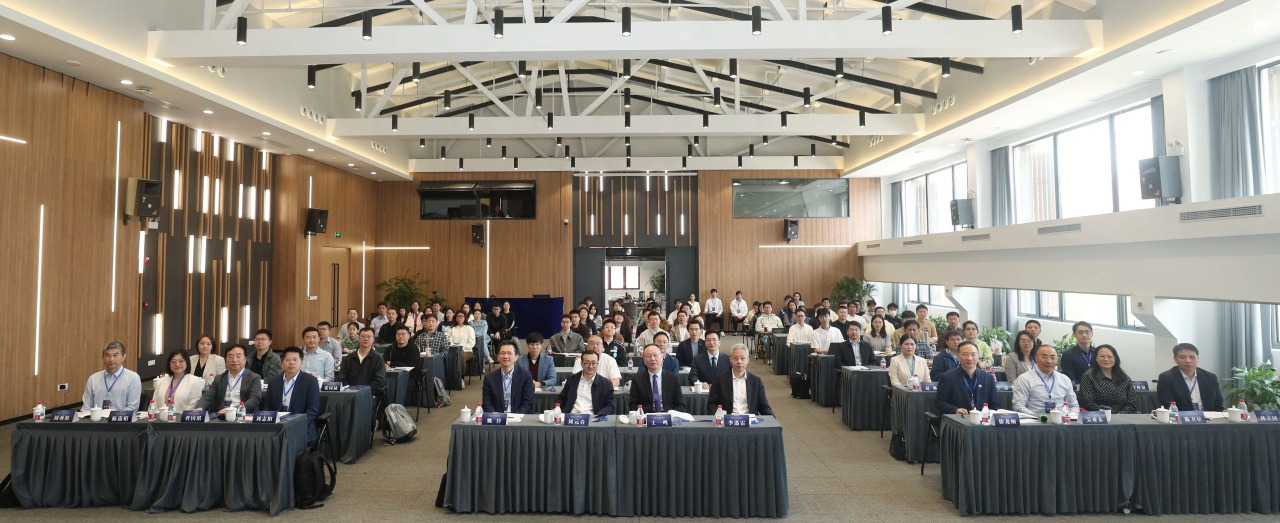
Focusing on the theme "China-US Trade in the Trump 2.0 Era," the forum released the 2025 First-Quarter Macroeconomic Special Report (click the link below for the full report). It analyzed the risks and opportunities facing China-US trade in the Trump 2.0 era as well as China's countermeasures, and held in-depth discussions on the driving forces and direction of China's future economic development and transformation.
Guests attending the meeting and delivering keynote speeches included Wang Yiming, Vice Chairman of the China Center for International Economic Exchanges; Yao Yang, Boya Distinguished Professor of Peking University, Director of the China Center for Economic Research, and Professor of the National School of Development; and Li Xunlei, Chief Economist of Zhongtai International.
The event was hosted by Shanghai University of Finance and Economics and organized by the Institute for Chinese Modernization at Shanghai University of Finance and Economics, the School of Economics at Shanghai University of Finance and Economics, and the China Macroeconomic Research Center at Shanghai University of Finance and Economics.
Liu Yuanchun, President of Shanghai University of Finance and Economics, attended the event and delivered a speech.
President Liu Yuanchun noted that since the Trump administration began its second term, the impact of the Trump 2.0 era has fully emerged. The super-era transformation it has brought, along with the profound adjustment of the China-US gaming landscape, has not only far exceeded previous expectations but also brought a high degree of uncertainty to the macroeconomic situation.
In recent years, China has responded to deglobalization and policy uncertainty under the "America First" principle with the policy certainty of persistently deepening opening-up. It has done so through a series of proactive opening-up policies, such as actively reducing restrictions on foreign investment access, optimizing the business environment, and orderly expanding the scope of unilateral visa-free countries.
He stated that, as a finance- and economics-oriented university, Shanghai University of Finance and Economics has taken proactive action by establishing the "China Macroeconomic Research Center," which brings together high-quality macroeconomic research forces at home and abroad.
Experts and scholars use their professional academic research capabilities and keen economic insight to deeply analyze the principles and essence behind macroeconomic phenomena. They deeply integrate the university's social service functions, always focus on major theoretical and practical issues in China's macroeconomic development, and are committed to providing the government and all sectors of society with economic insights, policy recommendations, and long-term governance solutions supported by solid academic foundations. In this way, the university is exploring a "SUFE model" on the path of serving national strategies, empowering regional development, and cultivating outstanding talents.
President Liu Yuanchun, Vice Chairman Wang Yiming, Professor Yao Yang, and Chief Economist Li Xunlei unveiled the China Macroeconomic Research Center of Shanghai University of Finance and Economics.
Zhao Lin, Associate Professor of the School of Economics at Shanghai University of Finance and Economics and Researcher of the China Macroeconomic Research Center, presented the 2025 First-Quarter Macroeconomic Special Report on behalf of the team.
The report argues that Trump 2.0 trade policy is extreme and full of uncertainty. The United States attempts to protect domestic employment and promote the return of manufacturing through tariffs, but there are logical contradictions in interest rate and exchange rate policies. Extreme trade policies may further intensify domestic contradictions in the United States.
In addition, regarding the current situation of China's foreign trade in the first quarter of 2025, the report shows that although China's foreign trade has been generally stable, it also faces challenges: weak import demand, long-term supply chain reconstruction issues, and corporate balance sheets being vulnerable to severe policy changes.
In response, the report recommends that in the short term, China should take advantage of the window of US inflationary pressure and implement diversified policies; in the long term, it is necessary to deepen reform and opening-up and enhance international discourse power.
In the keynote speech session, Vice Chairman Wang Yiming, Professor Yao Yang, and Chief Economist Li Xunlei spoke in turn.
Vice Chairman Wang Yiming delivered a keynote speech titled "Enhancing the Role of Domestic Demand as a Proactive Force and Stabilizing Anchor."
He noted that China's economy got off to a good start in the first quarter of this year, but it should still be recognized that sustained economic recovery and improvement still face challenges.
He recommended building a virtuous interaction mechanism for expanding investment and boosting consumption. More attention should be paid to investment in consumption upgrading sectors, and more attention should be paid to unlocking consumption potential through investments such as affordable housing construction and urban infrastructure renovation.
In addition, reform-oriented approaches should be used to attract social capital investment by opening access and rationalizing prices in service sectors and public utilities, so as to strengthen the domestic economic cycle and effectively respond to uncertainties in the external environment.
Professor Yao Yang delivered a keynote speech titled "The Impact of Trump's Tariffs on China and China's Countermeasures."
He advocated fundamentally boosting domestic demand and increasing fiscal support for local governments; stabilizing real estate to drive the recovery of housing-related industrial chains; proactively guiding and participating in the construction of new global trade rules; and systematically supporting enterprises going global to enhance global asset allocation capabilities.
Chief Economist Li Xunlei delivered a keynote speech titled "The Direction and Driving Forces of China's Economic Transformation."
He recommended that fiscal policy should actively play a role, industrial policy should coordinate the global layout of production capacity with domestic industrial transformation, and consumption stimulus should focus on innovation in the service sector.
He believes that the extreme pressure exerted by the US government this time has, to some extent, an incentivizing effect on China's economic transformation. In the future, it is necessary to advance a series of fiscal and tax system reforms to activate domestic demand, break rigidities, and promote the shift from "investment-driven" to "consumption-led" growth.
The research team of the China Macroeconomic Research Center at Shanghai University of Finance and Economics is rooted in the soil of China, upholds the mission of the times, focuses on international frontiers, and proactively aligns with national strategic plans and decision-making deployments.
It provides academic thoughts and solutions with both theoretical depth and practical effectiveness for national economic development, demonstrating the mission and wisdom of SUFE economists in building China's independent knowledge system in economics and on the new journey of Chinese-style modernization.
Xu Longbing, Executive Dean of the Institute for Chinese Modernization at Shanghai University of Finance and Economics, and Liu Zhiyang, Director of the Scientific Research Office, jointly chaired the event.
Zhou Yahong, Dean of the School of Economics at Shanghai University of Finance and Economics, and Lin Liguo, Party Secretary, attended the meeting.
Also present were Chen Xuanjuan, Executive Dean of the Dishui Lake Advanced Finance Institute at Shanghai University of Finance and Economics; Wu Huabin, Director of the China Macroeconomic Research Center at Shanghai University of Finance and Economics, and team members; and leaders, faculty, and students from the organizing units, including the Institute for Chinese Modernization at Shanghai University of Finance and Economics and the School of Economics at Shanghai University of Finance and Economics.
In addition, Chen Weixing, Chairman of the Supervisory Board of Pudong Development Group, and alumni guest representatives of the School of Economics at Shanghai University of Finance and Economics attended on site.
These included Cao Guoqi, Chairman of Softbank China Financial Group and President of the School of Economics Alumni Association; Wu Yadong, Chairman of Jiangsu Tianyou Household Products Technology Co., Ltd. and Executive Director of the School of Economics Alumni Association; and Zhang Qiu, General Manager of Shanghai Changyuan Investment Management Co., Ltd. and Secretary-General of the School of Economics Alumni Association.