On the afternoon of November 23, the 2024 SUFE Macroeconomics Forum was held in the lecture hall on the first floor of the Administration Building at Shanghai University of Finance and Economics. Focusing on the theme of "Digital Economy Empowering High-Quality Development," the forum analyzed and assessed the current economic development situation, the risks and opportunities encountered, and countermeasures, forecast China's economic growth rate and other key economic indicators, and held a special report on the digital economy and high-quality employment.
Guests attending the meeting and delivering keynote speeches included Qi Yingfei, Deputy Secretary of the Party Committee of Dongbei University of Finance and Economics; Zhang Jun, Dean of the School of Economics and Director of the China Center for Economic Studies at Fudan University, and Director of the Fudan-Ping An Macroeconomics Research Center; Li Xunlei, Chief Economist of Zhongtai International and Vice Chairman of the China Chief Economist Forum; Du Xiaoyu, Vice President of the Tencent Research Institute; and Wu Xuliang, Chief Economic Advisor of the Tencent Research Institute.
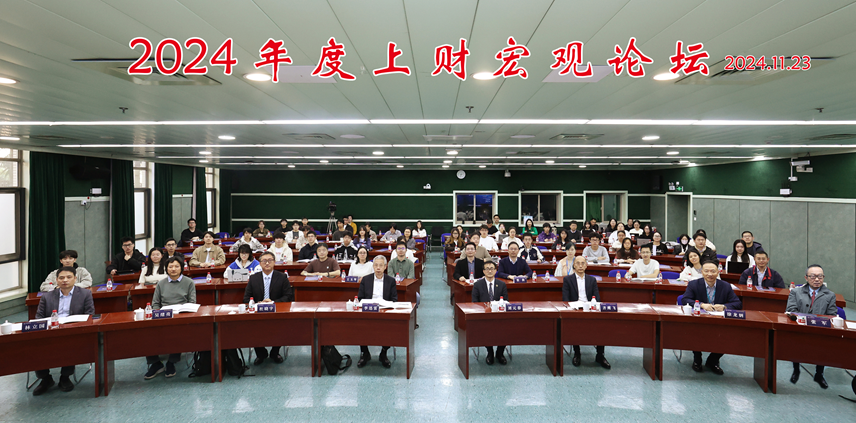
Liu Yuanchun, President of Shanghai University of Finance and Economics, and Du Xiaoyu, Vice President of the Tencent Research Institute, attended the meeting and delivered speeches.
Wu Huabin, Associate Professor of the School of Economics and a member of the SUFE macro team, released the 2024–2025 Annual Report on China's Macroeconomic Situation Analysis and Forecast: Digital Economy and High-Quality Employment on behalf of the team. The SUFE macro team stated that in 2024, China's macroeconomy is in a critical transitional period of shifting between old and new growth drivers. Geopolitical changes, deep adjustments in the real estate market, and the development of new quality productive forces driven by the fourth industrial revolution have become the three dominant forces shaping China's long-term macroeconomic development.
At the same time, affected by internal and external shocks, problems such as insufficient effective demand and weak expectations are relatively prominent in the short term. Although many difficulties and risks exist, China's overall economic and social development has remained stable, and high-quality development has been solidly advanced. The annual GDP growth rate is expected to be 5.0%, and the target growth rate set during the "Two Sessions" at the beginning of the year is expected to be achieved. 2025 is the final year of the 14th Five-Year Plan.
To do a good job in economic work for the coming year, it is necessary to deeply understand the spirit of the Third Plenary Session of the 20th Central Committee, continue to adhere to the general working tone of prioritizing stability and seeking progress while maintaining stability, correctly grasp the key bottlenecks constraining China's achievement of high-quality development, identify long-accumulated deep-seated contradictions and hidden risks, and inject new momentum into high-quality development-led economic recovery.
From the perspective of the macroeconomic situation, on the supply side, the service industry has generally grown and industry has recovered strongly, but it is worth noting that the value added of the real estate industry has continued to experience negative growth, dragging down the year-on-year growth rate of the value added of the construction industry. On the demand side, the recovery in consumption remains weak, and the momentum for recovery still needs to accumulate; the growth rate of fixed asset investment has rebounded modestly, manufacturing investment has remained steady, infrastructure investment has slowed somewhat, and real estate investment has remained sluggish; the growth rate of foreign trade has turned from negative to positive, and its structure has continued to improve. Regarding macroeconomic policy, affected by domestic local government debt, local fiscal revenue and expenditure are under pressure at both ends; against the backdrop of U.S. interest rate cuts, supportive monetary policy has been coordinated and accommodative. The research group believes that the structural risks facing China's macroeconomic development in the next stage include the risk of low-level operation, real estate risk, and external demand risk.
At present, the continuous rise of the digital economy's position in China's economy has not only profoundly changed the structure of the job market but also brought challenges to improving employment quality. In order to maximize its role in promoting high-quality employment, the team believes that the following comprehensive measures should be taken: first, strengthen skills training and vocational education; second, improve the labor security system; third, accelerate the construction of regional digital infrastructure; fourth, promote the matching of supply and demand for high-skilled positions; fifth, support the digital transformation of key industries such as banking and the development of inclusive finance; and sixth, improve the regulatory framework and strengthen control over issues such as data security, algorithmic fairness, and employment inequality, so as to ensure the inclusiveness and sustainability of digital economy development。
After the report was released, the session moved on to the keynote speech. Qi Yingfei delivered a keynote titled "Making Innovation More Powerful." He stated that, in the long term, a country's per capita income growth mainly originates from total factor productivity growth, which is technological progress, and that innovation and knowledge dissemination are crucial for total factor productivity growth. China’s scientific and technological innovation has achieved remarkable results, with continuous emergence of innovative achievements and constant enhancement of innovation capabilities.
In 2022, nationwide R&D expenditure exceeded 3 trillion yuan RMB, and R&D intensity surpassed the average level of European Union countries. The number of invention patent applications has continued to grow, maintaining the world’s top position since 2011. However, the contribution of scientific and technological innovation to total factor productivity has not been fully realized, with the average annual growth rate of total factor productivity over the past 15 years being about 1%. To understand the divergence between the growth of patent applications and the growth of total factor productivity, a classification analysis of patents reveals that patents reflecting disruptive technological innovation promote total factor productivity, while patents reflecting technology following may even have a negative impact on total factor productivity improvement.
Current preferential policies based on the number of patents, to some extent, incentivize enterprises to apply for follower patents and expand subsequent follower innovation through knowledge spillover channels, which may ultimately suppress disruptive innovation. General Secretary Xi Jinping's new productivity theory emphasizes disruptive innovation, clearly indicating that new productivity is generated through revolutionary technological breakthroughs, innovative allocation of production factors, and deep industrial transformation and upgrading, with a significant increase in total factor productivity as its core indicator. Therefore, regarding policy recommendations, Qi Yingfei believes that the innovation policy system should shift from "supporting innovation" to "supporting disruptive innovation," addressing the driving force problem for high-quality development through the development of new productivity.
Zhang Jun delivered a keynote speech titled "A Conceptual Framework for Better Understanding China's Macroeconomy." He pointed out that the Chinese economy is undergoing a rapid and profound transformation. From the perspective of the transformation framework, the main issue in the macroeconomy is not insufficient demand but supply shocks. Exogenous shocks, such as changes in external geopolitics, digital transformation, major policy adjustments in the real estate sector, and the COVID-19 pandemic, have had far-reaching impacts on various industries, disrupting the previously stable business models in the economy.
For example, digital transformation is altering the structure of the labor market, shifting traditional employment patterns; adjustments in real estate policies have undermined the stability of upstream and downstream industry chains; all these supply shocks are creating increasing uncertainty across various sectors of the economy, and it is this rise in uncertainty that changes the demand behavior of households and businesses. Companies, guided by industrial policies, are rapidly transitioning to emerging fields, leading to crowded new tracks and overcapacity in many sectors. Households face declining job security and income expectations, resulting in a downgrade in consumption.
In facing the growing pains of China's current economic supply transformation, he reviewed the background of macroeconomic policy shifts in recent years. From the supply-side structural reforms starting in 2015, to policy tilts toward high-tech industries after the trade war in 2018, and now to the development of new quality productivity and future-oriented industries, China's policy focus has consistently been on adjusting the industrial structure and promoting technological innovation. These policies inject new momentum into the economy but also increase the uncertainty of economic growth.
Currently, many emerging industries are experiencing excessive competition, and traditional industries are under mounting pressure, further amplifying market uncertainty. Therefore, he proposed that policy design should start with reducing uncertainty, emphasizing a balance between short-term shocks and long-term goals, to provide a more stable market expectation and development environment for enterprises and households. Furthermore, regarding the application of economic theory, he argued that traditional textbook economic theories are often designed under idealized conditions, and when analyzing China's current macroeconomic reality, it must be placed within the broader context of large-scale structural adjustments and transformation pains in China to truly understand the essence of the problems, avoiding a simplistic application of Western theoretical models.
Li Xunlei delivered a keynote speech titled "The Inevitability and Challenges of China's Economic Shift Toward Consumption-Led Growth." He believes that a consumption-led approach is the inevitable path for high-quality economic development, but this transformation faces numerous structural difficulties. The United States' additional tariffs on China, restrictions on investments, and implementation of deglobalization policies have exerted significant pressure on China's exports. The International Monetary Fund (IMF) predicts that the global economy may stabilize at a low level by 2025, which will further suppress China's export growth. In the context of an increasingly complex global economic environment, China must pay greater attention to domestic demand, particularly enhancing the contribution of consumption to economic growth.
He first explored the current state of China's economy, pointing out that the country's investment-driven model has shown signs of fatigue, primarily reflected in negative growth in real estate investment, declining investment returns, and underutilization of manufacturing capacity. Data show that in the first three quarters of 2023, retail sales of consumer goods increased by 3.3% year-on-year, while service consumption grew by 7.2%, reflecting a relatively rapid recovery in service consumption, yet overall consumption recovery remains weak.
He then analyzed China's weak consumer position from a global comparative perspective, noting that China's final consumption accounts for 55.7% of GDP, significantly lower than developed countries such as the United States (81.6%) and Japan (75.1%). The main reasons for this phenomenon include unequal income distribution, insufficient consumer confidence, and the long-term investment-dominated economic growth model. China's capital formation accounts for over 40% of GDP, double the global average, but it is accompanied by high leverage and increasing debt risks. In 2023, China's macro leverage ratio reached 287.8%, with a household leverage ratio exceeding 60%, comparable to developed countries but rising much faster than in the United States and Japan.
He then discussed the difficulties of consumption transformation and policy recommendations. He pointed out that the rigid income structure and slowing growth are major obstacles to promoting consumption. On one hand, the median growth rates of urban and rural residents' incomes are 4.4% and 6.8% respectively, lower than the overall needs of economic development; on the other hand, the downturn in the real estate market has exacerbated the fragility of residents' balance sheets, further weakening consumer confidence. Meanwhile, the heavy burden of local government debt and the continued decline in returns on infrastructure investment have constrained the government's ability to support consumption.
Finally, he proposed specific policy recommendations to promote consumption transformation. In the short term, measures such as issuing consumption vouchers and encouraging the upgrade and replacement of durable goods should stimulate residents' consumption potential; in the medium to long term, fiscal and tax reforms should optimize the income distribution structure and accelerate the reform of consumption tax and personal income tax. He particularly emphasized the need to strengthen central government expenditure responsibilities in areas such as education, healthcare, and elderly care, thereby reducing local government financial pressure and laying a more solid foundation for expanding consumption.
Xu Xuliang delivered a keynote speech titled "Intelligent Economy, Affluent Society, and High-Quality Employment." He pointed out that China's macroeconomy is currently in a period of "slowdown and gear shift," and that the intelligent economy will become the second growth curve. The rise of the intelligent economy, through technology diffusion and resource reallocation, helps drive economic structural transformation and productivity improvement. He further explored the micro mechanisms and industrial logic of the intelligent economy. From a micro perspective, the intelligent economy affects not only the industrial side but also the consumer side, influencing the macroeconomy from both supply and demand ends. From a broader framework, the intelligent economy gradually penetrates industries in the sequence from the service sector to industry, and then to agriculture. This diffusion order helps mitigate the "Baumol effect" and improve overall total factor productivity of the economy.
Regarding the impact of the intelligent economy on employment, he noted that in the 1930s, economist Keynes predicted that over the next hundred years, the world would experience rapid technological progress, leading to a large-scale "technological unemployment." However, in the past century, although technological progress has indeed occurred, large-scale "technological unemployment" has not materialized. The impact of technology on employment includes two main effects: substitution effect and creation effect. Based on economic data from the past two centuries, in the short term, the substitution effect exceeds the creation effect, while in the long term, the opposite is true—that is, the jobs created by technology far outnumber the jobs replaced. It is generally believed that although AI has some unique characteristics, it still follows this fundamental law, and the relationship between humans and AI is not a zero-sum game.
He emphasized that discussions on AI's impact on employment require a structured classification study of AI, analyzing in detail how different types of AI technologies and products affect various industries, work scenarios, and even specific tasks, as general research is of limited value. Additionally, it is necessary to examine the relationships between employment quantity and quality, new occupations and old skills, traditional employment and flexible employment, human capital and industrial structure evolution, and employment polarization and income distribution.
Finally, he proposed policy recommendations to address AI employment challenges: balance technological advancement with employment stability, strengthen AI's employment creation effect, fully leverage the role of industrial internet and digital transformation in stimulating innovation and entrepreneurship, and expand AI's job creation effects; enhance government support for vulnerable workers and allow innovative enterprises to operate with agility; strengthen structured research to identify vulnerable groups and group employment risks to prevent them in advance; promote the development of new occupations and job positions, encourage the creation of human-AI collaborative employment opportunities, reduce barriers to occupational transition, optimize industrial and labor structures compatible with new technologies, and relax market-based certification for training in cloud computing and AI.
The forum is jointly organized by Shanghai University of Finance and Economics and Tencent Research Institute, and co-organized by the Institute of Chinese-Style Modernization at Shanghai University of Finance and Economics, the School of Economics of Shanghai University of Finance and Economics, the Key Laboratory of Mathematical Economics of the Ministry of Education, the Dishui Lake Think Tank of Shanghai University of Finance and Economics, and the Dishui Lake Advanced School of Finance of Shanghai University of Finance and Economics. The forum is co-hosted by Xu Longbing, Executive Dean of the Institute of Chinese-Style Modernization at Shanghai University of Finance and Economics, and Lin Liguo, Party Secretary of the School of Economics. The forum is broadcast live on multiple video channels including the School of Economics of Shanghai University of Finance and Economics, the Dishui Lake Advanced School of Finance of Shanghai University of Finance and Economics, and Tencent Research Institute.
For 16 years, the SUFE Macro Team, as a university think tank, has consistently published macroeconomic reports, rooted in China, keeping pace with the trends of the times, and providing advice and suggestions for China's economic development. Looking ahead, the SUFE Macro Team will continue to proactively align with national strategic plans and policy decisions, demonstrating the mission and responsibility of SUFE economists in the construction of China's self-reliant economic knowledge system and the new journey of Chinese-style modernization.