With the support and care of the schools and colleges, currently, the School of Economics at Shanghai University of Finance and Economics is meticulously developing the academic brand series 'Managing the World and Benefiting the Nation · Frontier of Politics and Economics.' Relying on a range of significant academic projects, including academic papers, scholarly works, academic seminars, lectures, and research reports, the school is further expanding new horizons for the development of our political economy discipline. On the new journey of Chinese-style modernization, it aims to contribute the wisdom and strength of the School of Economics at Shanghai University of Finance and Economics to the construction of China's economic theoretical system, knowledge system, and discourse system.
As an important activity of the 2024 Political Economy "Series of Academic Seminars," and to further enhance academic exchange and mutual learning in political economy, consolidate consensus on the development of the discipline, and promote the high-level construction and high-quality development of the theoretical and discursive system of socialism with Chinese characteristics in political economy, on November 16, the School of Economics of Shanghai University of Finance and Economics held a Political Economy Academic Seminar themed "Improving Systems and Mechanisms to Promote High-Quality Economic Development" in Conference Room 402 of the Auxiliary Building. The seminar was attended by over 30 experts and scholars from 14 top domestic universities, including Peking University, Tsinghua University, Renmin University of China, Fudan University, Nanjing University, Nankai University, Wuhan University, Xiamen University, Southwestern University of Finance and Economics, Shanghai International Studies University, Shanghai University of International Business and Economics, Shanghai Academy of Social Sciences, East China Normal University, and Shanghai University of Finance and Economics, as well as by editorial boards of 《Academic Monthly》, 《Shanghai Economic Research》, and 《Journal of Shanghai University of Finance and Economics》. The Shanghai Social Science Innovation Research Base "Research on the Innovative Discourse System of Political Economy of Socialism with Chinese Characteristics in the New Era," the Xi Jinping Institute of Economic Thought at Shanghai University of Finance and Economics, and the editorial board of 《Journal of Shanghai University of Finance and Economics》co-organized the seminar.
Opening Ceremony
In his speech, He Pengcheng, Deputy Secretary of the Party Committee and Secretary of the Discipline Inspection Commission of Shanghai University of Finance and Economics, introduced the development of the political economy discipline at Shanghai University of Finance and Economics. He emphasized that the university has always attached great importance to and provided comprehensive support for the development of the political economy discipline. He expressed the hope that the experts and scholars attending the event would offer valuable advice and strong support, jointly promoting the discipline to new heights and cultivating more outstanding economics talents with an international perspective, innovative spirit, and practical abilities for national economic construction and social development.
Professor Zhou Yahong, Dean of the School of Economics at Shanghai University of Finance and Economics, pointed out in her speech the key tasks of discipline construction at the current stage. She noted that based on the mainline of the discipline’s development, the integration and mutual learning of interdisciplinary approaches can promote and advance both the theory and practice of political economy. She also stated that in the digital era, strengthening the construction of discipline textbooks is equally important. Efforts should continue to advance political economy research in various fields and directions, including mathematical political economy, to further improve the quality of talent cultivation.
The opening ceremony of this conference was hosted by Professor Mao Peihua, Vice Dean of the School of Economics, leader of the political economy discipline, and chair professor at Shanghai University of Finance and Economics. Professor Mao extended a warm welcome and gratitude to all the attending experts and introduced the basic situation of the university’s ongoing effort to build the academic brand series "Economic Governance and Frontiers of Political Economy." He pointed out that this seminar is an important event within this brand, which will further expand the development space of the university’s political economy discipline and contribute the wisdom and strength of Shanghai University of Finance and Economics’ political economy discipline to the new journey of Chinese-style modernization.
Keynote Reports
After the opening ceremony, the seminar proceeded to the keynote report session, chaired by Professor Lin Liguo, Party Secretary of the School of Economics at Shanghai University of Finance and Economics.
Professor Ding Renzhen, former Party Secretary and President of Sichuan Normal University, member of the Theoretical Economics Discipline Evaluation Group of the Academic Degrees Committee of the State Council, and Professor at Southwestern University of Finance and Economics, delivered a keynote report titled "Strategic Characteristics of Further Deepening Economic System Reform in the New Era." He conducted an in-depth analysis of the strategic characteristics of China's economic system reform in the new era, stating that deepening reform is the inevitable path to promoting Chinese-style modernization, to liberating and developing productive forces, to improving the socialist market economy system and mechanism, and to advancing the modernization of the national governance system and governance capacity. He also outlined the specific tasks of economic system reform in the new era.
Professor Ren Baoping, Dean of the School of Digital Economy and Management at Nanjing University and a specially appointed professor for the Ministry of Education's national talent program, delivered a keynote report titled "From Integration of Digital Economy with Real Economy to Integration of Real Economy with Digital Economy." He profoundly explained the significance of shifting from deep digital-real integration to deep real-digital integration, and systematically demonstrated how to achieve this transition, how to realize the digitalization of the real economy and the embodiment of the digital economy, and how the two can combine to promote the new qualitative development of the real economy.
Xie Fusheng, Editor-in-Chief of Renmin University of China Press and a specially appointed professor for the Ministry of Education's national talent program, delivered a keynote report titled "Developing New-Quality Productive Forces According to Local Conditions." He analyzed the theoretical connotations and functional logic of developing new-quality productive forces from three dimensions: relevant statements by General Secretary Xi Jinping, the theoretical basis of Marx's productive forces, and the carriers of new-quality productive forces. He also focused on proposing pathway considerations for developing new-quality productive forces according to local conditions.
Keynote Reports
Following this, the meeting entered the keynote report session. The first keynote report was chaired by Ma Yan, a senior professor at the School of Economics of Shanghai University of Finance and Economics and chief expert at the Shanghai Social Science Innovation Research Base.
Professor Zhang Hui, Vice Dean of the School of Economics at Peking University, provided a systematic discussion on the development of productivity theories, the concept of new-type productivity and its formation conditions, as well as the practical paths and development principles of new-type productivity. He emphasized the importance of properly handling key relationships such as traditional industries versus strategic emerging industries, government versus market, and independent innovation versus open innovation.
Professor Gao Fan, Deputy Director of the Publicity Department of the Party Committee at Fudan University and a young scholar under the Ministry of Education’s national talent project, stated that China’s series of discussions and initiatives on new-type productivity have formed a complete and innovative productivity theory, highlighting the systematic characteristics of productivity orientation, performance, generation, and assurance, representing a localized proposition.
Professor Liu Zhen, Vice Dean of the China Modern State-Owned Enterprise Research Institute at Tsinghua University and a tenured professor at the School of Marxism, held that digital productivity is an important manifestation of new-type productivity. He analyzed the specific performance of digital productivity in the four stages of social reproduction from the perspective of Marxist social reproduction theory and pointed out that digital productivity is key to promoting the integration of digital and physical economies.
Professor Ye Chusheng, Co-Director of the Economic Development Research Center at Wuhan University, a key research base of humanities and social sciences under the Ministry of Education, expounded on the developmental economics orientation of new-type productivity. He argued that as a pioneering and original concept, new-type productivity reflects the new requirements, directions, and ideas for the economic development priorities of developing countries after reaching the upper-middle-income stage, having general significance in practice worldwide.
Professor Zhang Yugui, Party Secretary of the School of International Finance and Trade at Shanghai International Studies University, explored strategic considerations for the high-quality development of China’s manufacturing industry in the context of the global manufacturing landscape reshaping, analyzed the background and reasons for China-US strategic competition, and emphasized China’s breakthroughs in scientific and technological development and the importance of talent.
The second keynote session was chaired by Shen Min, Editorial Reviewer of the journal Academic Monthly.
Professor Ge Yang, Executive Deputy Director of the National Center for the Study of Socialist Political Economy with Chinese Characteristics at Nanjing University, explored the role of integrated factor markets in promoting productivity leaps. He emphasized that cultivating new quality productivity requires accelerating the construction of a unified domestic factor market, and based on an analysis of the current state and problems of segmented factor markets in China, proposed corresponding solutions.
Professor Gai Kaicheng, Dean of the School of Economics at Southwestern University of Finance and Economics, proposed a theoretical analytical framework of new quality productivity with Chinese characteristics, encompassing driving forces, factor structure, development foundation, and institutional guarantees. Based on this framework, he analyzed the theoretical, contemporary, and methodological implications of developing new quality productivity.
Professor Zhang Xingxiang, Chair of the Department of Economics at the School of Economics, Xiamen University, analyzed the importance and necessity of promoting new quality productivity through institutional innovation. Based on several practical cases, he proposed a path for developing new quality productivity by deepening the “streamline administration and delegate power, improve regulation, and upgrade services” reform.
Researcher Chen Guozheng from the Institute of Economics, Shanghai Academy of Social Sciences, systematically elaborated on the inheritance, goals, and realization path of Chinese-style modernization. He stated that the goal is to build a socialist modernized strong country and achieve the great rejuvenation of the Chinese nation, while the path includes adhering to the Party’s leadership, centering on the people, comprehensively deepening reform, and adhering to the new development philosophy.
The third keynote session was chaired by Researcher Yang Wei from the Institute of Chinese Marxism, Shanghai Academy of Social Sciences.
Professor Ma Yan, School of Economics, Shanghai University of Finance and Economics, systematically elaborated on the theoretical foundation, underlying logic, action mechanism, quantitative verification, and policy recommendations for the deep integration of the real economy and the digital economy. She pointed out that the key to integration lies in the production sector and extends progressively through exchange, distribution, and consumption.
Professor Qiao Xiaonan, School of Economics, Nankai University, analyzed the significant importance of the digital economy for the high-quality development of the real economy. Using the social reproduction network model, he explored the mechanisms and impacts of the integrated development of the digital and real economies, and finally proposed a series of policy recommendations based on empirical analysis.
Professor Li Zhengtou, Distinguished Professor at the School of International Finance and Trade, Shanghai International Studies University, and the first Social Science Luminary at Shanghai Academy of Social Sciences, made a distinction between fundamental, basic, and important institutions. He argued that reasonable institutions are a crucial condition for promoting productivity development and improving resource allocation efficiency. The institutional arrangements of socialism with Chinese characteristics provide strong guarantees for China’s rapid economic development and long-term social stability.
Professor Wang Chaoke, Director of the Center for Capital and Chinese Political Economy at Shanghai University of International Business and Economics, proposed a new concept of the "Holographic System of Productivity" and discussed, from this perspective, how to establish new types of production relations. He argued that a system conducive to individuals, institutions, and enterprises investing in technology innovation should be established, government support for technological sectors should be strengthened, and social culture’s tolerance for technological innovation should be continuously enhanced.
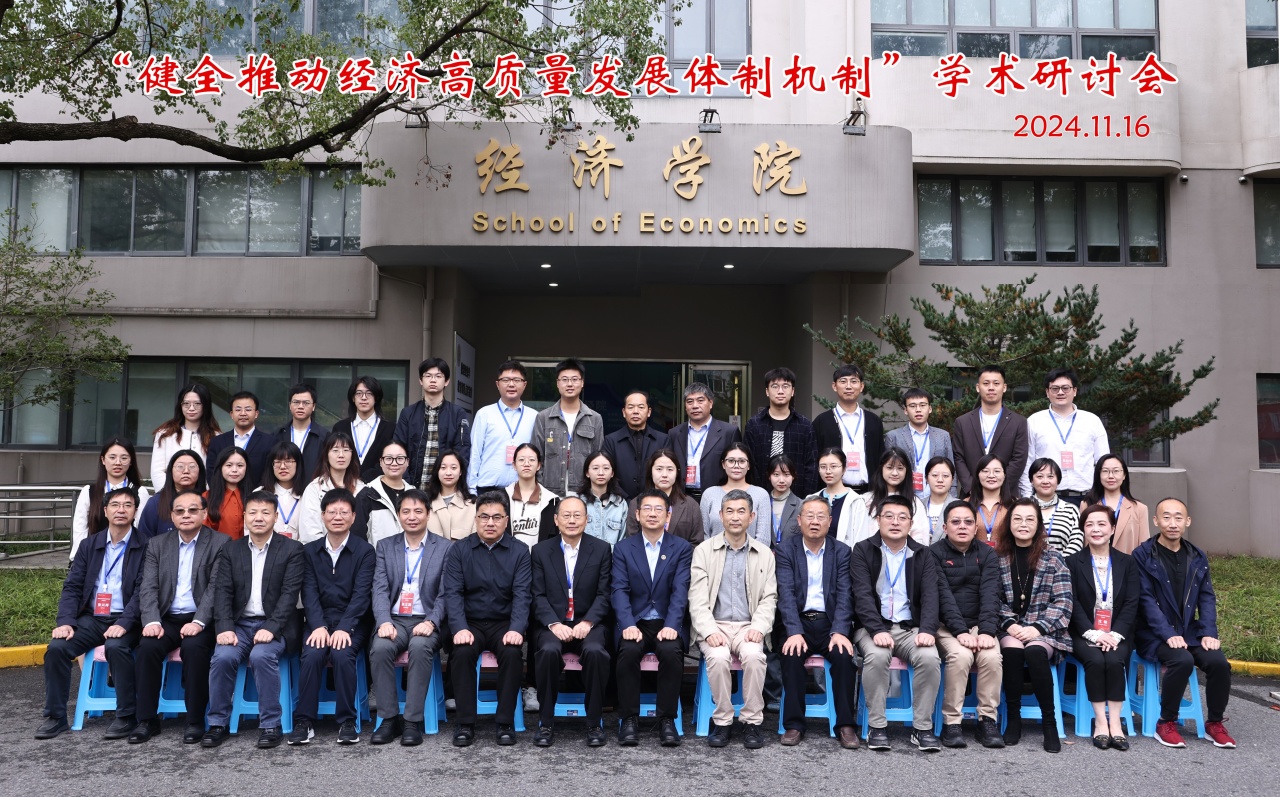
Finally, Professor Mao Peihua gave a brief summary of the meeting and once again expressed gratitude to the participating guests for their contributions, looking forward to the discipline of political economy achieving new and greater development opportunities through everyone's joint efforts and attention.