On the afternoon of November 12, 2024, the Shanghai Summit Labor Economics Workshop was successfully held at the School of Economics, Shanghai University of Finance and Economics. The workshop explored important research topics in labor economics from the perspectives of technology, culture, and education. The workshop was jointly organized by the Shanghai Institute of International Finance and Economics at Shanghai University of Finance and Economics, the School of Economics at Shanghai University of Finance and Economics, the School of Economics at Fudan University, and Antai College of Economics and Management at Shanghai Jiao Tong University. Faculty and students from Shanghai University of Finance and Economics, Fudan University, Shanghai Jiao Tong University, East China Normal University, ShanghaiTech University, Shanghai University, Shanghai University of International Business and Economics, Shanghai Lixin University of Accounting and Finance, and other universities participated in the workshop.
The first session was chaired by Professor Huang Feng of the School of Economics, Shanghai University of Finance and Economics. Professor Xu Lingli of the School of Economics, Shanghai University, and Assistant Professor Luo Sai of the School of Economics, Shanghai University of Finance and Economics, presented their reports respectively.
Professor Xu Lingli of the School of Economics, Shanghai University, presented on "Parenting Styles and Children's Income: A Study Based on Chinese Micro-Family Data." Using the China Family Panel Studies (CFPS), this paper innovatively examines the impact of parenting styles on the income of adult children. The author employs the generalized random forest method for estimation. The results show that, with respect to adult children's income and income growth rate, among the four parenting styles—authoritative, authoritarian, neglectful, and permissive—the authoritative style is relatively the best, followed by the permissive style, while the authoritarian and neglectful styles are relatively disadvantageous, with the authoritarian style having the most adverse impact on income. Heterogeneity analysis results show that for sons, the authoritative parenting style is superior to the authoritarian style. For daughters, the neglectful style should not be chosen, and the permissive style has a greater promoting effect on income than other parenting styles.
Assistant Professor Luo Sai of the School of Economics, Shanghai University of Finance and Economics, presented on "Ethnic Neighborhoods and Assimilation: Evidence from Full Count Historical Census Data." Using U.S. historical census data (1900–1940), this paper studies the impact of exposure to immigrant communities during childhood on the adult outcomes of the descendants of immigrant families. Using the causal identification method of Chetty and Hendren (2018) and based on a family fixed effects model, the results find that increased exposure to immigrant communities raises adult income levels. This effect varies across different ethnic groups.
The second session was chaired by Associate Professor Jiang Helu of the School of Economics, Shanghai University of Finance and Economics. Associate Professor Chen Yi of the School of Entrepreneurship and Management, ShanghaiTech University, and Associate Professor Huang Zibin of the College of Business, Shanghai University of Finance and Economics, presented their reports respectively.
Associate Professor Chen Yi of the School of Entrepreneurship and Management, ShanghaiTech University, presented on "A Small Fish in a Big Pond? The Long-Term Consequences of Marginal Enrollment in Elite Universities." This study matches college entrance examination admission data from 1999 to 2003 with consumption records from more than a decade later to analyze the long-term effects of entering elite universities. Using a regression discontinuity approach, it finds that people who just barely entered elite universities have relatively lower housing expenditures in the future. This may be because their class rankings during university were relatively low, their majors were less competitive, and they were more likely to settle in economically less developed cities. This study reveals that, in the long run, success depends not only on the school one attends but is also affected by many other factors.
Associate Professor Huang Zibin of the College of Business, Shanghai University of Finance and Economics, presented on "Growing without Gentrification: The Impact of Technology on Low- and High-skilled Migration in China." Based on census data from 2005, 2010, and 2015, this study explores the impact of technological progress on labor migration at different skill levels in China. Through reduced-form estimation and structural estimation methods, the study finds that patent innovation simultaneously raises the incomes of both low-skilled and high-skilled groups. In the migration process, low-skilled labor attaches greater importance to income, while high-skilled labor attaches greater importance to urban amenities. This causes patent growth to attract more low-skilled labor to rapidly developing regions, thereby reducing the ratio of high-skilled to low-skilled labor in these regions. This study shows that over the past two decades, technological progress in China has not, as has occurred in some Western countries, led to gentrification in developed regions, but has instead promoted the common development of both low-skilled and high-skilled labor.
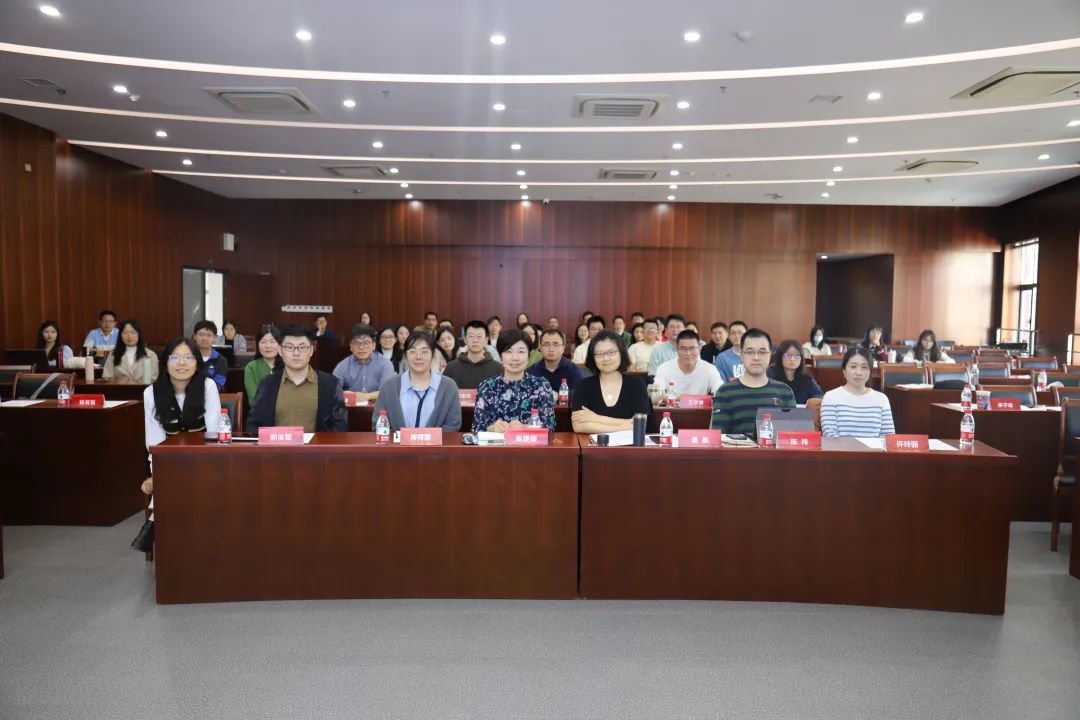
This workshop provided a valuable platform for exchange among outstanding scholars in the field of labor economics at universities in Shanghai. Faculty and students from various institutions shared the latest research findings and frontier developments in labor economics at the meeting. The forum not only promoted academic exchange and the collision of ideas but also brought participants rich academic inspiration and valuable research experience.