Econometrics faculty recently had three papers accepted for publication in the internationally reputed journals: Associate Prof. Kai Yang’s paper “Estimation of Dynamic Panel Spatial Vector Autoregression: Stability and Spatial Multivariate Cointegration” accepted for publication in Journal of Econometrics, Associate Professor Chao Yang’s paper “Estimation of a SAR Model with Endogenous Spatial Weights Constructed by Bilateral Variables” accepted for publication in Journal of Econometrics and Professor Yahong Zhou’s paper “Semiparametric Estimation of a Censored Regression Model Subject to Nonparametric Sample Selection” accepted for publication in Journal of Business and Economics Statistics.
The Department of Econometrics has always regarded research and innovation as an important part of core competitiveness in discipline construction. Adhering strictly to the standards of first-class discipline construction, it actively explores and innovates ways to optimize the efficiency of achievements from the School’s continuing education reform, develop international research projects anchored on national circumstances and promote research at the frontier areas, doing its best to contribute to discipline construction.

Kai Yang, Associate Professor, Ph.D. Economics, The Ohio State University
Research: Econometrics, Applied Microeconomics
Course Teaching: Advanced Econometrics, Intermediate Macroeconomics
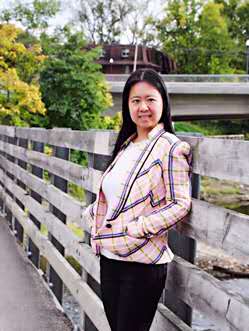
Chao Yang, Associate Professor, Ph.D. Economics, The Ohio State University
Research: Microeconometrics, Applied Econometrics
Course Teaching: Statistics, Microeconometrics, Financial Economics

Yahong Zhou, Professor with Tenure, Dean of the School of Economics, Ph.D. Economics from The Hong Kong University of Science and Technology, PhD Supervisor, Distinguished Professor of National Talent Plans, New Century Excellent Talent
Abstract of the Papers:
Estimation of Dynamic Panel Spatial Vector Autoregression: Stability and Spatial Multivariate Cointegration
Kai Yang and Lung-fei Lee
Abstract: This paper introduces dynamic panel spatial vector autoregressive models. We study features of dynamics and spatial interactions that an SVAR model can generate and classify the model into stable or unstable cases by partitioning parameter spaces. For stable, spatial cointegration, and mixed cointegration cases, we investigate identification and QML estimation of the models to take into account simultaneity and correlated relationships. Asymptotic properties and bias-corrected estimators are presented. To detect unknown cointegration relationships, we introduce a sequential likelihood ratio testing procedure. Simulations show the advantage of QMLEs on bias reduction and efficiency gains. The empirical application provides evidences on ancient China’s market integration.
Estimation of a SAR Model with Endogenous Spatial Weights Constructed by Bilateral Variables
Xi Qu, Lung-fei Lee and Chao Yang
Abstract: This paper studies the estimation of a cross-sectional spatial autoregressive (SAR) model with spatial weights constructed by bilateral variables like the trade or investment between regions. We model the possible endogeneity in spatial weights due to the correlation between the error term in the SAR model and unobserved interactive fixed effects in bilateral variables. Using a control function approach, we propose two-stage estimation methods and establish their consistency and asymptotic normality. Finite sample properties are investigated by a Monte Carlo study. We further apply our method to an empirical study of interactions among different US industries through production networks.
Semiparametric Estimation of a Censored Regression Model Subject to Nonparametric Sample Selection
Zhewen,Pan, Xianbo Zhou and Yahong Zhou
Abstract: This study proposes a semiparametric estimation method for a censored regression model subject to nonparametric sample selection without the exclusion restriction. Consistency and asymptotic normality of the proposed estimator are established under mild regularity conditions. A Monte Carlo simulation study indicates that the estimator performs well in various designs and outperforms parametric maximum likelihood estimators. An empirical application to female smoking is provided to illustrate the usefulness of the estimator.